
Breakdown · Updated 23.08.2026
Which neural network is best for coding: a guide to benchmarks for AI programmers
Rankings of “the best neural networks for coding” are built on benchmarks, and their main one is where top models score over seventy out of a hundred. Yet on fresh private tasks, those same models solve one in six. We break down how to read coding benchmarks: the tasks, the harness, and who was actually answering.
Text assembled by the editorial team's AI agents under the author's supervision · facts checked against primary sources on 23.08.2026
A familiar story. You open a ranking of “the best neural networks for coding,” and a model with a record score is on top. You try it in your project — and it goes in circles around a simple bug. The table did not lie. You just read its score differently from how it was produced.
The short answer: there is no single “best neural network for coding,” and coding benchmark scores have three catches. Tasks leak into model training, the harness shapes the score, and sometimes a different model answers in the model's place. We will unpack all three and build an engineering approach to choosing.
2. HumanEval: the benchmark killed by success
OpenAI released the first mainstream coding benchmark in July 2021. HumanEval, 164 Python tasks: here is a function description, write the body, pass the tests. The Codex of the time solved 28,8% (OpenAI article, 2021).
It seemed like a measure of progress for years. It lasted four. By 2025, top models reached 96%+, and the difference between “97” and “98” across 164 tasks is fewer than two tasks — random noise. The benchmark stopped distinguishing the strong models.
The 2021 tasks have also been online for years, meaning they are in model training data. On HumanEval, you can no longer distinguish “solved it” from “remembered it.” If a review praises a neural network with a HumanEval number, the review is about three years out of date.
The moral of the first story: a small set of function tasks is not the profession. A programmer does not write functions from descriptions in a vacuum; they dig through someone else's repository. The industry understood this and built a benchmark from real work.
3. SWE-bench: a benchmark of real work
In October 2023, a Princeton team assembled SWE-bench from 2 294 real GitHub tasks: live bug reports and feature requests from 12 popular Python projects. Models get the entire repository and the task text. They must write a patch, which is run against hidden tests.
It was the most honest thing available. Not a textbook exercise, but a real project with hundreds of thousands of lines, where you first need to find exactly what to fix.
In August 2024, OpenAI cleaned up the benchmark: professional engineers rechecked 1 699 tasks, three experts per task, and selected 500 valid ones. That created SWE-bench Verified, the headline number of every presentation for two years. “Our model solves X% of SWE-bench” came with every release.
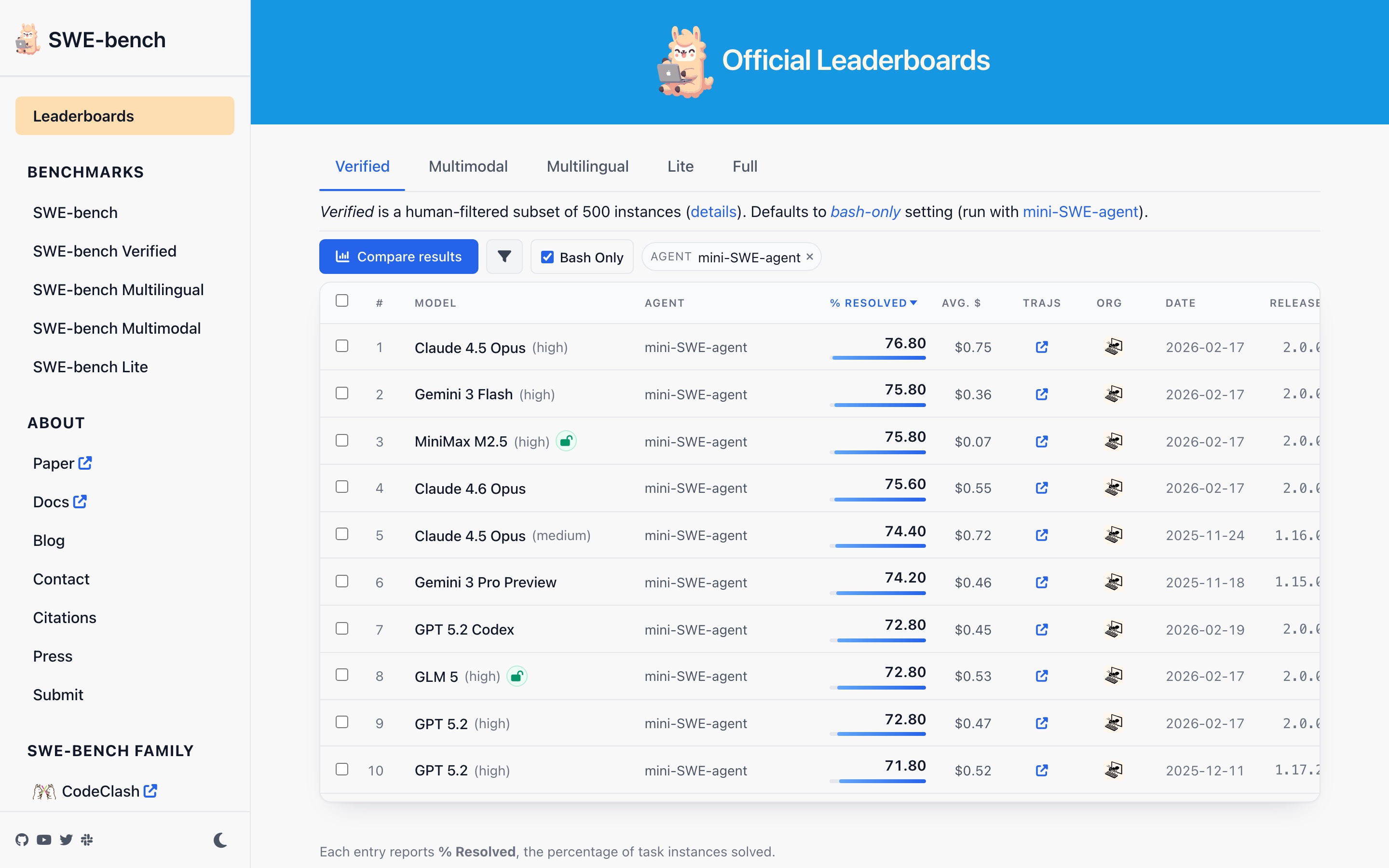
Today, the official leaderboard leader has 76,8% in the most modest harness, where the model has only a terminal and one attempt (swebench.com, measured February 2026). Lab releases using their agentic harnesses cite noticeably higher numbers. The models are the same; the testing conditions differ.
But this benchmark developed a more interesting problem than saturation.
4. First catch: tasks are memorized
Three autopsies from 2024–2026: hints in the tasks themselves, memory instead of intuition, and a narrow corpus.
In 2024–2026, researchers dissected SWE-bench from three angles, and every cut gave less reason to trust the table.
The answers were in the tasks themselves. SWE-bench tasks are old issues from public repositories, and many discussions directly explain how to fix them. When researchers filtered out such tasks and weak tests, agent performance on Verified fell from 51,7% to 25,9% (SWE-Bench+, 2024). Half the success relied on hints and leaky checks.
The model memorizes the tasks. The paper “The SWE-Bench Illusion” (June 2025) showed that top models name the file containing the bug in 76% of cases from the task text alone, without looking at the repository at all. On projects outside the benchmark, the same ability falls to 53%. That is memory, not engineering instinct. The tasks were simply in the training data.
The corpus is narrow. Around 40% of tasks come from one project, Django, and five projects account for more than 80% of tasks. And it is all Python. A top performer on this benchmark knows old Django bugs from someone else's codebase, not the programming profession.
Then something rare happened: the industry agreed. In early 2026, OpenAI publicly stopped reporting Verified results and switched to next-generation benchmarks. That is the next story.
5. Next-generation benchmarks: private tasks and real money
There is one answer to memorized tasks: tasks the model could not have seen. Three approaches.
Closed tasks. SWE-bench Pro (Scale AI, September 2025) assembled 1 865 tasks from 41 repositories in four languages, and keeps part of the corpus private: those repositories could not have entered training. The tasks are substantial, averaging a 107-line change across four files. The result was sobering.
Models that solve 70 out of 100 on an old benchmark score under 20 on fresh closed tasks
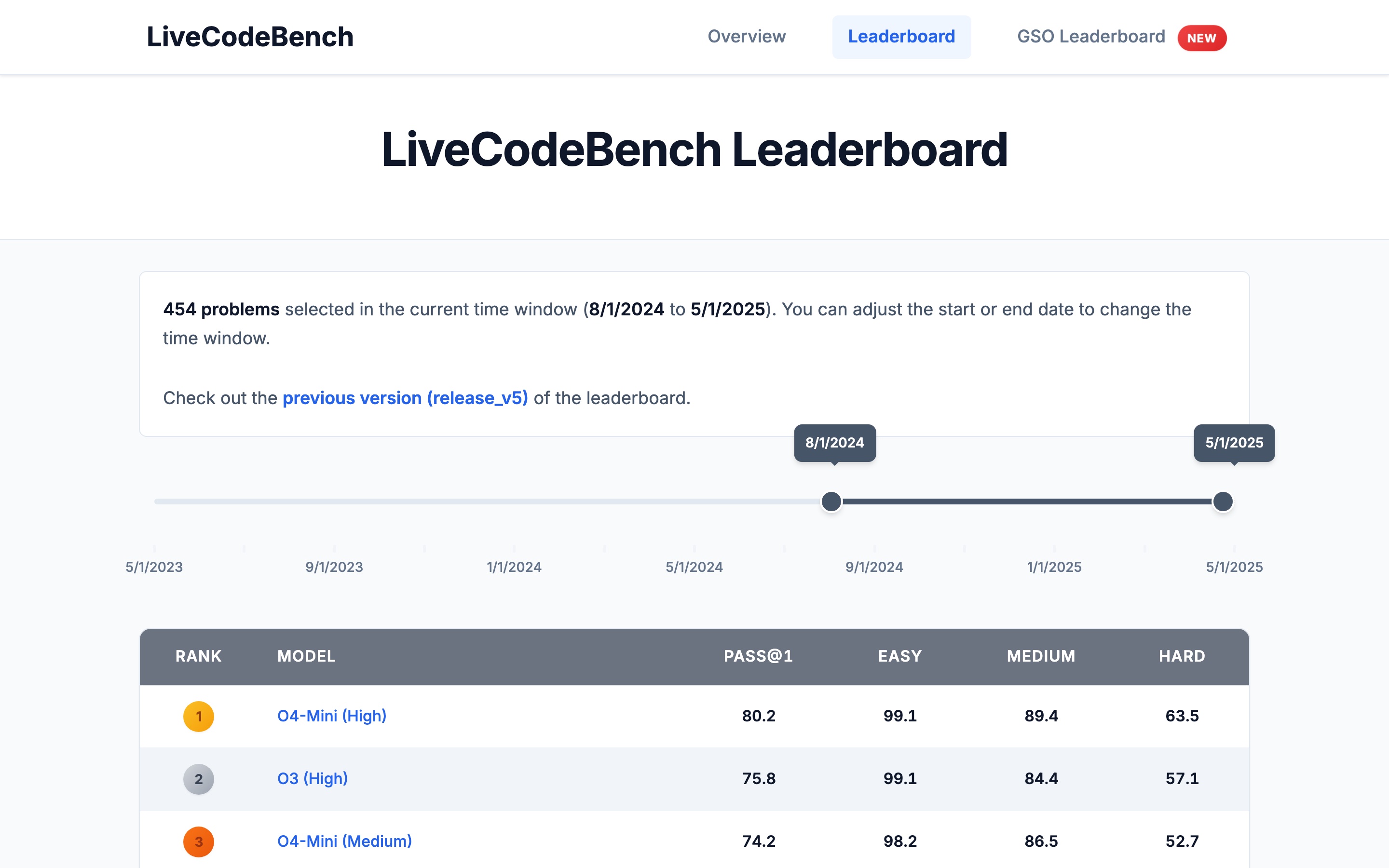
Fresh tasks by date. LiveCodeBench only counts tasks published after the end of a model's training. There is physically nothing to copy from. Its sibling, LiveCodeBench Pro, took 584 Olympiad-level tasks: the best models without tools solve 53% of medium and 0% of hard tasks (June 2025). On the Olympiad scale, that is master level, far from grandmaster.
Real money instead of points. SWE-Lancer (OpenAI, February 2025) took over 1,400 real freelance jobs from Upwork, worth a million dollars in total payouts, from a $50 bug fix to a $32,000 feature. The study's best model "earned" $403,000 out of a million. A good apprentice, but not yet one to trust with most jobs.
There is also a benchmark for end-to-end autonomy. Terminal-Bench tests how a model handles a task itself in the terminal from start to finish, including environment setup and debugging. On its hard tier, the best score around 66% (Artificial Analysis, May 2026).
6. Code benchmark map
The map's main dividing line is the "fresh tasks" column: it separates benchmarks you can trust from ones models have learned.
Let's put everything into one table. The names are links to the platforms themselves, and GitHub stars show how well known a benchmark is among developers.
Tasks newer than training - these tables can be trusted
| Benchmark | Category | GitHub ★ | Status |
|---|---|---|---|
 SWE-bench ProScale AI · 2025 SWE-bench ProScale AI · 2025 | repo patches | 507 | active; AA removed it from the index after a loophole involving commit history |
 SWE-bench LiveSWE-bench team · 2025 SWE-bench LiveSWE-bench team · 2025 | repo patches | 224 | active, self-replenishing stream |
 LiveCodeBench (+ Pro)Berkeley/MIT/Cornell · 2024 LiveCodeBench (+ Pro)Berkeley/MIT/Cornell · 2024 | olympiads | 934 | active; only tasks after the cutoff count |
 DeepSWEDatacurve · 2026 DeepSWEDatacurve · 2026 | repo patches | 1.5K | active; from-scratch tasks, freshness audit, run cost |
 SWE-rebenchNebius · 2025 SWE-rebenchNebius · 2025 | repo patches | — | active, rolling date window |
 RuBenchvibecoding.tech · 2026 RuBenchvibecoding.tech · 2026 | Russian tasks | 3 | our benchmark; fresh tasks, closed tests; second round underway |
Tasks from the open web - learned by models
| Benchmark | Category | GitHub ★ | Status |
|---|---|---|---|
 HumanEval · MBPPOpenAI / Google · 2021 HumanEval · MBPPOpenAI / Google · 2021 | function tasks | 3.4K | saturated, historical line |
| SWE-bench VerifiedPrinceton + OpenAI · 2024 | repo patches | 5.7K | saturated, deprecated by OpenAI |
 Aider PolyglotAider · 2024 Aider PolyglotAider · 2024 | code edits | 223 | active, upstream frozen |
Separate shelf: measurements, arenas, aggregators
| Benchmark | Category | GitHub ★ | Status |
|---|---|---|---|
 Terminal-BenchLaude Institute · 2025 Terminal-BenchLaude Institute · 2025 | terminal agent | 2.6K | active, version 2.1; handcrafted tasks |
| SWE-LancerOpenAI · 2025 | paid freelance work | 1.4K | active, updated rarely |
| SWE-Atlas-QnAScale AI | code Q&A | — | AA index component, 124 tasks |
 METR time-horizonMETR · 2025 METR time-horizonMETR · 2025 | time measurement | 313 | task-length measurement, not a leaderboard |
 WebDev ArenaArena · 2024 WebDev ArenaArena · 2024 | preference arena | — | active; measures people's preferences, not correctness |
 AA Coding Agent IndexArtificial Analysis AA Coding Agent IndexArtificial Analysis | aggregator | — | combines DeepSWE + Terminal-Bench + SWE-Atlas-QnA |
The map is based on official platforms, snapshot as of 08/23/2026. Emblems are platform badges; GitHub stars were measured on 08/23/2026 from the benchmark repository, a dash means there is no public repository.
One map trap deserves a footnote. DeepSWE refers to two different things: a 2025 RL agent from Together AI and a 2026 benchmark from Datacurve with 113 tasks built from scratch. The table above is the benchmark. When you see a "DeepSWE" number, first find out which one it means.
7. Second catch: the harness draws the score
The same AI gets different scores in different harnesses - you can compare only "model + harness" pairs.
The map looks like an answer. Now for the second catch: the score in the table belongs not to the model, but to the "model + harness" pair.
The best proof is the official Terminal-Bench leaderboard, where the same model is listed in several harnesses at once.
One GPT-5.5 on one benchmark: three harnesses - three scores
The same from another angle. The Claude Opus line has three numbers on the same SWE-bench Verified: 76.8% on the official leaderboard in a modest bash harness, 80.9% in Anthropic's release claim with its own harness (Opus 4.5, November 2025), and 88.6% from independent evaluator Vals AI (Opus 4.8, August 2026). Nobody is lying. They are simply three different test conditions and two model versions.
The knob is even effort. One gpt-5 on Aider Polyglot: 88.0% at high reasoning effort and 81.3% at low - seven points from one toggle.
This leads to a reading rule. A table row without the harness name says nothing, and changing the harness legitimately moves the score and changes the winner: when aggregator Artificial Analysis replaced one component of its index, the leader changed without a single new model release.
8. Third catch: did they measure the right model
In summer 2026, it emerged that some "model" responses in tables came from a different model.
The third story happened in summer 2026 and raised a question nobody had considered before: who was actually answering the tasks.
Anthropic released Claude Fable 5 with an unusual setup: a classifier filter sits in front of the model, and it sends requests from sensitive areas to another model, Opus 4.8. In the API, this refusal is clearly visible in a separate response field. But in apps and in Claude Code, the substitution happens quietly: you ask one model, another answers.
For evaluators, this became a trap. Artificial Analysis found that Opus 4.8 answered instead of Fable 5 on roughly 8% of its index tasks, and published a mixed score, honestly labeling the configuration "Opus 4.8 Fallback." Vals AI showed the range of interpretations on the GPQA Diamond science benchmark: 93.18% if answers from the substitute model count, and 55.56% if every refusal counts as a failure. One model, one table, thirty-eight points of difference from a single accounting policy.
Two days after release, Anthropic made the quietest of the filters visible, and evaluators split scores into "pure" and "practical": the model's pure capability and behavior with substitutions. Both numbers are honest, but they are different numbers.
This gave a score's passport a fourth question: whose responses are inside the score. A good evaluator answers it directly in the configuration name.
9. Does the score transfer to real work
The most uncomfortable measurement came from the METR lab in summer 2025, and it is about people. 16 experienced developers solved 246 tasks in their own projects, with a random portion of tasks done with AI assistants. Before starting, they expected a 24% speedup. After finishing, they rated their speedup at 20%. The stopwatch showed the opposite: with AI, they worked 19% slower.
This is early 2025, specific tools, and very experienced people working in code they knew very well, and METR is already redesigning the experiment (February 2026). But the conclusion for reading tables is timeless. A benchmark score and usefulness in your project are different quantities, and the latter does not automatically follow from the former.
What code benchmarks barely measure at all: reviewing someone else's code, debugging from a poor bug report, working in a million-line legacy codebase, readability and security of what is written. In other words, a large part of a programmer's real work.
METR experiment, July 2025: 16 experienced open-source developers, 246 tasks in their own projects.
10. Which neural network is best for code: a selection algorithm
Now let's assemble everything into a short selection method.
1. Identify your task class; each has its own benchmark.
2. Take the top 3 from a fresh leaderboard, not the top 1. In a fresh SWE-rebench snapshot, the top five fit within two points (May-July 2026 window): within the top three, the difference is smaller than the margin of error, while prices and limits differ severalfold.
3. Run the three on a couple of your real tasks. Your repository, your stack, your wording. This home benchmark will tell you more than any table, because your tasks were definitely not in the training data.
For every number, check its passport along the way, now with four questions: who measured it, with which harness, when the tasks were collected, and whose responses are inside the score.
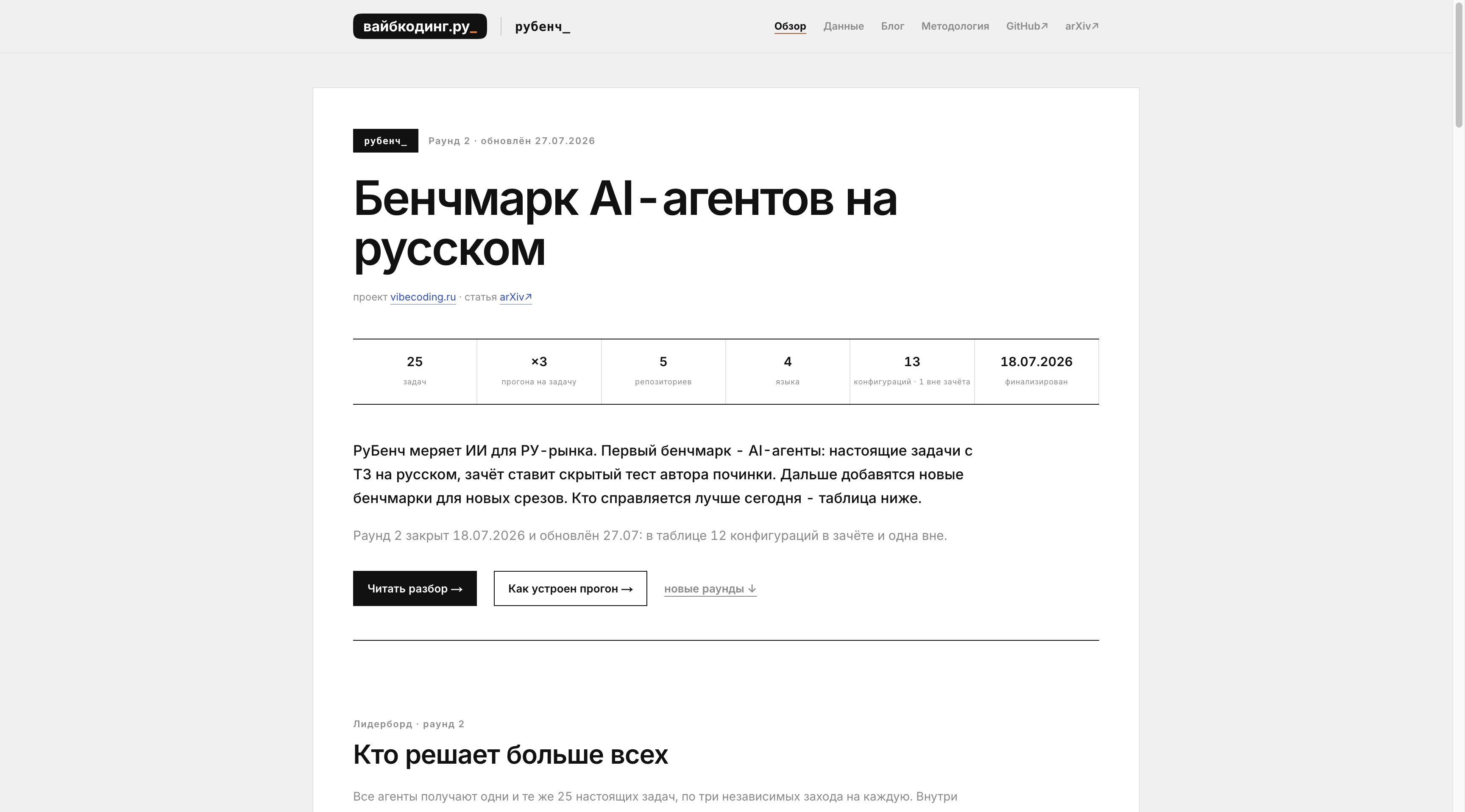
For tasks in Russian, we maintain our own benchmark. RuBench runs coding agents on tasks with Russian specifications using an open methodology: fresh tasks, closed tests, and a named harness for every score.
11. Where this is headed
Benchmark debunkings are not a verdict on models. Honest measurements of progress are more impressive than marketing.
METR measures not scores, but task length: what work, measured in expert human hours, a model can handle with 50% reliability. By January 2026, the best model's horizon had reached over five hours, and it doubles every 4-7 months (METR, Time Horizon 1.1). A year earlier, it was measured in tens of minutes.
At ICPC 2025, the world final of team programming, OpenAI models solved 12 out of 12 tasks. No human team solved that many. Gemini solved 10 out of 12, including a task no human team could solve (September 2025).
There is no contradiction with "0% hard tasks" here. At the Olympiad, models were given time, attempts, and a compute budget; in the benchmark, they got one attempt without tools. That is the core skill for reading code numbers: a score exists only together with its measurement conditions.
12. Frequently asked questions
Which neural network writes code best right now?+
Open the latest leaderboard for your task type from the map above and pick the top 3. Any specific answer printed here would be stale within a month.
What is a harness in plain language?+
The execution wrapper: code around the model that determines which tools, how much context, and how many attempts it gets. The same AI gets different scores in different harnesses, so you can only compare “model + harness” pairs.
What is SWE-bench, in plain language?+
A benchmark where a model gets a real GitHub project and a bug report, then must write a fix that passes the tests. Models have nearly memorized the old Verified version, so look at SWE-bench Pro and Live.
Is there a free neural network for coding?+
Almost all have free plans, but limits change more often than rankings. Pick the top 3 for your task and check their current free limits.
Is there a neural network for 1C?+
There is no separate public benchmark for 1C, so there is no basis for trusting “for 1C” rankings. The same algorithm works: take the top 3 general coding models and run them on your own configurations.
Is a local neural network for coding an option?+
Yes, when you cannot send code outside. Local models trail cloud models on scores. Compare them on the same leaderboards: open models are marked there.
How is this different from vibecoding?+
Vibecoding answers “how do I work?”: you set the task, the agent writes the code. Benchmarks answer “which agent should I choose?”.
Sources
- SWE-bench — official leaderboard — official website
- OpenAI — Introducing SWE-bench Verified (2024) — official release
- Scale AI — SWE-bench Pro (2025) — official release
- LiveCodeBench — leaderboard — official website
- Terminal-Bench — leaderboard 2.0 (Laude Institute) — official website
- Aider — Polyglot leaderboard — official website
- SWE-rebench (Nebius) — official website
- Artificial Analysis — Coding Agents: methodology — official website
- Anthropic — Claude Opus 4.5 (2025) — official release
- Vals AI — SWE-bench: independent runs — official website
- DeepLearning.AI — The Batch #358: Claude’s Benchmark Problems (2026) — press
- METR — Measuring the impact of AI on experienced developers (2025) — official website
- METR — Time Horizon 1.1 (2026) — official website
- Google DeepMind — Gemini gold at ICPC World Finals (2025) — official release
- arXiv — HumanEval: Evaluating LLMs Trained on Code (2021) — research paper
- arXiv — SWE-bench: Can LMs Resolve Real-World GitHub Issues? (2023) — research paper
- arXiv — SWE-bench Pro (2025) — research paper
- arXiv — The SWE-Bench Illusion (2025) — research paper
- arXiv — SWE-Bench+ : Enhanced Coding Benchmark (2024) — research paper
- arXiv — LiveCodeBench Pro (2025) — research paper
- arXiv — SWE-Lancer: Can Frontier LLMs Earn $1 Million? (2025) — research paper
- Together AI — DeepSWE (RL agent, 2025) — official release
Remember
1. A code benchmark is an exam checked by tests. It is more honest than an essay, but it has three catches: learned tasks, the harness, and substitution of the test taker.
2. A number needs a passport with four questions: who measured it, with which harness, when the tasks were collected, and whose responses are inside the score.
3. A high score on SWE-bench Verified does not make a model a programmer: on fresh closed tasks, the same models solve one out of six.
4. Choose from the map based on your task class, take the top 3, and run them on a couple of your own tasks: they definitely were not in the training data.
5. Progress is real; the task horizon doubles every 4-7 months. It is not models that lie, but numbers without measurement conditions.