September 24, 2026
AI agents take on work beyond code: Opus 5.5 downloaded 5,000 archival files
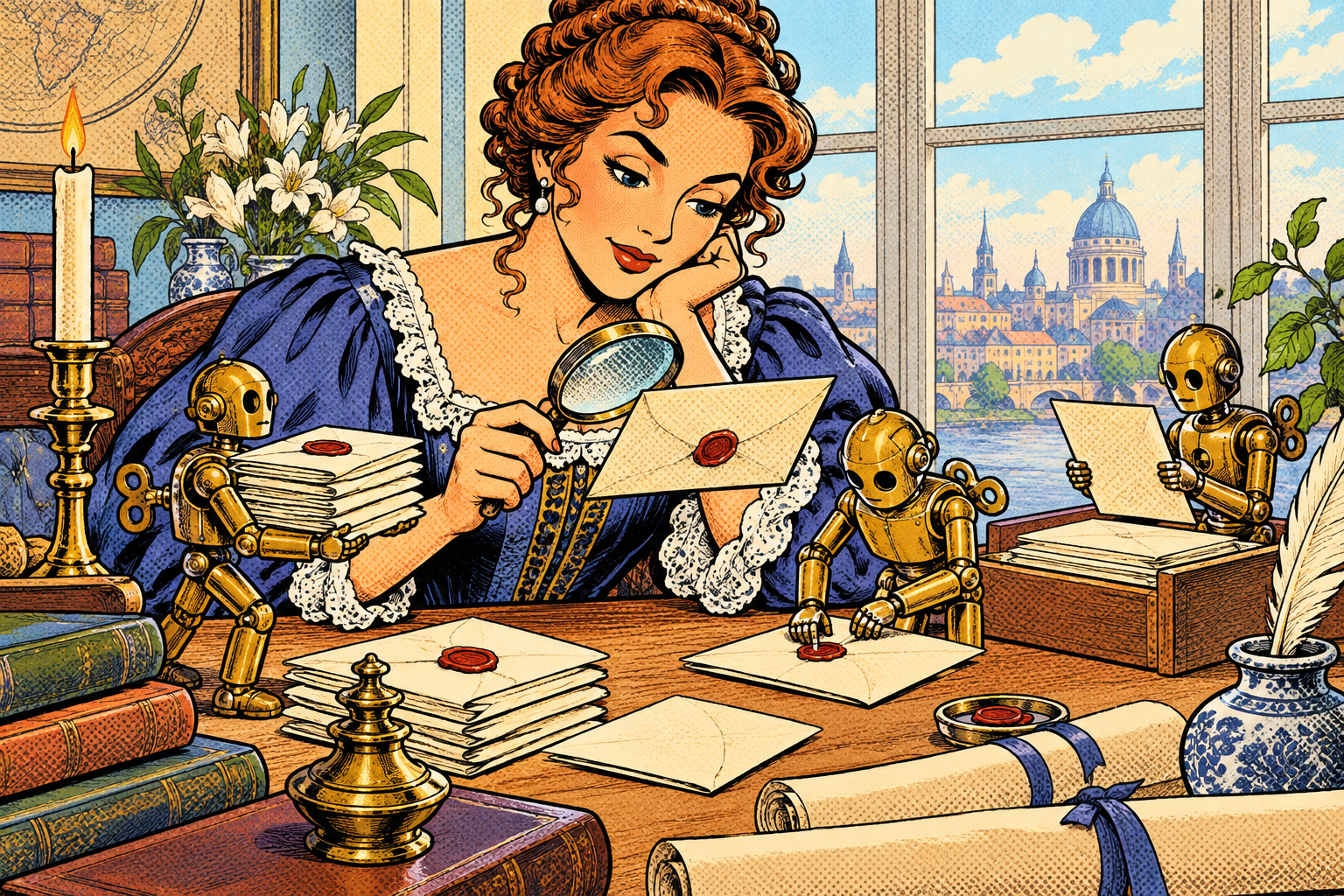
On Sep 24, Opus 5.5 downloaded more than 5,000 archival files and delegated searches across Google Books and archival websites to subagents. Researcher Benjamin Breen used GPT-6 and Opus 5.5 to cross-check sources in different languages and test hypotheses about 17th-century manuscripts.

In 2024–2025, Breen did not consider such tasks feasible for models. He now identifies five conditions: experts have already formulated the question, the data is digitized, the task suits a language model, mathematics, or agentic search, code can be written for the specific case, and there is something to verify the result against.
Checking answers. Opus 5.5 noticed that Isaac Newton and Samuel Hartlib encoded Hungarian vitriol differently. Matches in codes, quantities, and text fragments gave Breen reason to suggest that Hartlib's manuscript became a source for Newton. The model also partially deciphered two 16th-century Spanish letters encrypted with Charles V's cipher: one was already deciphered in the 1530s, the other in 1916, so the known text made it possible to check its interpretations.
Not every mystery. Searching for new ciphers from the First and Second World Wars produced no results: Breen believes the obvious finds have already been picked over. Daniel Bourdeau's open journal contains 275 historical ciphers: 244 attempts have been completed, 25 decryptions were obtained from ciphertext alone, and 52 challenges remain unsolved. His repository combines archival search, historical cribs, 19th-century printed editions, small solvers, and control comparisons.
Breen sees the main limitation as access to archives: many documents are digitized but closed to most researchers.
Breen proposes opening archives, funding digitization, and giving historians free API access with compute for hundreds or thousands of agents.