
Analysis · Published Sep 27, 2026
A subscription is 35x cheaper than the API: we counted the tokens of a site that agents have been building for three months
If vibecoding.tech paid for every token at API list prices, the build since July 1, 2026 would have cost $52,208, while subscriptions over the same period came to $1,494. The 35x gap is the subscription multiple, and we broke it down by model, agent and day so that the choice between a subscription and an API key can be made with the numbers in hand.
Text assembled by the newsroom's AI agents under the author's supervision · facts checked against primary sources Sep 27, 2026 · the token counter is open at /open/api-costs
You search for "claude code subscription" or "codex limits" and get a price per million tokens that says nothing about a month of work. We counted a month for real: the site is built by AI agents Claude Code and Codex, every message of theirs sits in the transcripts, and counter multiplied it all by public prices.
The most awkward thing about these numbers: until September 27 our own counters did not know them, two tools were lying in opposite directions. We counted by the public Anthropic and OpenAI price lists, and we publish only this site's figures.
1. What Claude Code and Codex cost: one site's bill
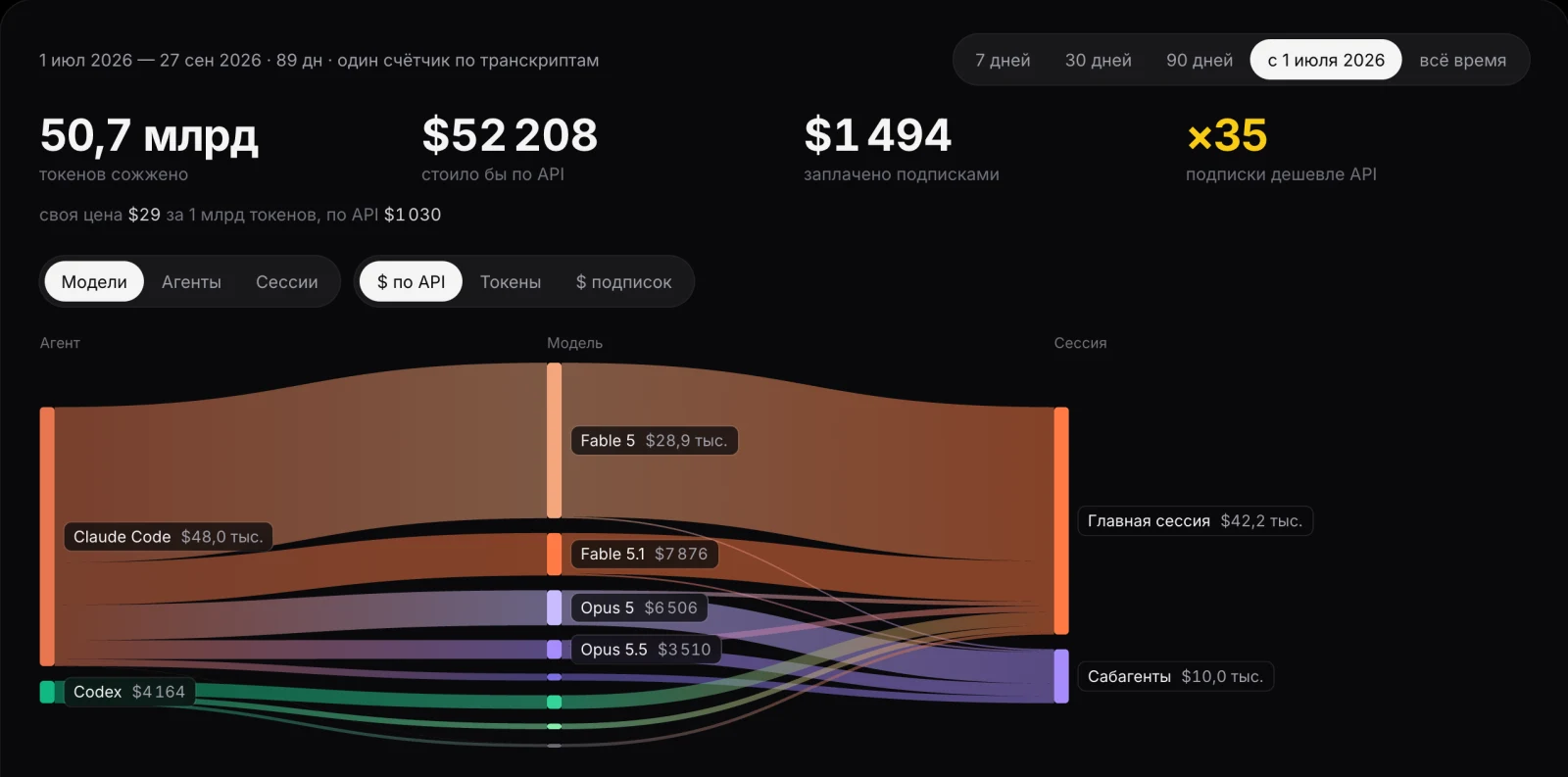
Over three months the agents that build vibecoding.tech burned 50.7B tokens (project counter, July 1 - September 27, 2026). At API prices that is $52,208. Subscriptions over the same period cost $1,494, a 35x difference.
A token is a chunk of text, about four characters of English (Anthropic, pricing page, Sep 27, 2026). A million tokens equals roughly four million characters, and 50.7B add up to 200B characters the machine read and wrote over the summer and September, including re-reading its own history. Per month that works out to about $17,900 at API prices and about $511 with subscriptions, across 2.92 months of building.
Neither of the two sums sits on an invoice. The $52,208 comes from a calculation: that is what the same work would have cost if every token had been billed at the Anthropic and OpenAI price lists. The $1,494 comes from an allocation. A subscription is spread across the days of its period, the day's money is split between models by their share of API dollars inside the vendor, and the site gets its share.
The live figures, broken down by models, agents and days, are open on the counter page. On /open the same numbers are recalculated per month in the section on the cost of the machine versus a team.
2. Why a subscription is 35x cheaper than the API: the subscription multiple
Thirty-five is the subscription multiple, a number that is on no price tag. The multiple shows how much machine time at API prices one dollar paid for a subscription buys. For model vendors' own subscriptions it runs into the dozens: the vendor subsidizes the subscriber's code. The calculation across the whole market, from Codex and Claude Code to Cursor, is in the article AI subscriptions.
Where all those tokens come from. The API has no memory: on every turn the agent sends the model the entire conversation history again, that is how the Messages API works according to Anthropic's documentation. A session of two hundred steps means the same files and the whole exchange have been read two hundred times, and every time those are input tokens.
The cache softens it, it does not cancel it. The model can set aside a chunk of the conversation it has already read and take it from memory next time instead of reading it again, and that is what the cache is. A cache read on Claude Fable 5.1 costs $0.25 per million tokens against $10 for regular input, but a cache write is more expensive than input: ×1.25 for the five-minute cache and ×2 for the one-hour one (Anthropic pricing, Sep 27, 2026). Our counter accounts for both, and it still comes out to $52,208.
A subscription works differently. You pay a flat fee, and the vendor protects itself with a limit on the amount of work in a time window. That is why people with a subscription ask not about the price but about the limits.
Who is better off with the API. Someone who goes to the model rarely and without an agent. At Fable 5.1 list prices $20 buys 2M input tokens or 400,000 output ones, and for a few questions a day that lasts for months. For an agent building a site that is less than a day: our average day at API prices cost $587 (52,208 over 89 days).
3. Which models ate the money: a table by model
More than half of the API bill was run up by one model. Claude Fable 5 burned 17.9B tokens for $28,855, which is 55% of the whole $52,208. The expensive model is not the one with the higher list price but the one you burn more of: Fable 5 and Fable 5.1 have the same input and output price, $10 and $50 per million, yet 5.1 came out 3.7 times cheaper.
The bill by model for three months, July 1 - September 27, 2026
vibecoding.tech token counter, snapshot Sep 27, 2026. Prices from the Anthropic price lists and the LiteLLM registry for OpenAI. GPT-6 Astra and two Codex rows have no published price, their cost is estimated from GPT-5.6 Sol pricing. Average price per million = money ÷ tokens, it is below list price because of cache reads.
The two Fables have the same input and output price and differ only in cache reads: $1 per million on Fable 5 and $0.25 on Fable 5.1 (Anthropic pricing, Sep 27, 2026). An average million cost $1.61 on Fable 5 and $0.87 on 5.1.
Claude Opus 5.5 burned more tokens than Opus 5, 9.5B against 7.7, and cost almost half as much, $3,510 against $6,506. The 5.5 list price is lower on every line, $4 and $20 per million against $5 and $25, cache reads $0.20 against $0.50 (Anthropic pricing, Sep 27, 2026). The price of the same work falls faster than the appetite grows.
OpenAI models play a secondary role in our bill: GPT-5.6 Sol $2,541, GPT-5.5 $1,039, GPT-6 Astra $360. Astra and two Codex rows have no published price, so the counter estimated them at the Sol price and flagged the estimate on the page.
4. Subagents: extra spend or savings
Subagents burned 30% of the tokens and 19% of the bill at API prices. The main session ran up 35.2 billion tokens for $42,185, subagents 15.5 billion for $10,023 (project counter, Sep 27, 2026). An average million cost $0.65 in a subagent and $1.20 in the main session.
The reason is a rule: the expensive model thinks and decides, the cheap one does the rough work. The main session runs on Claude Fable, while repository recon, edits across many files and layout from a brief go to subagents on Claude Opus. A subagent starts with a clean context, reads only what its task needs, and does not drag the history of the big session along with it.
Who burned it: agents and sessions, July 1 – September 27, 2026
Token counter of vibecoding.tech, snapshot Sep 27, 2026. The share of the bill is counted against $52,208 at API prices. Subscriptions are split across agents, not sessions.
Codex was our second agent: part of the machinery over the summer and automatic code review, with the main building done by Claude Code. Codex accounted for 10% of the tokens and 8% of the bill.
5. How the bill changed month by month and what happened on September 6
August turned out to be the most expensive month: $29,503 at API prices, 57% of the whole bill. July came to $3,915, September through the 27th $18,790 (project counter, Sep 27, 2026).
Bill by month
Token counter of vibecoding.tech, snapshot Sep 27, 2026.
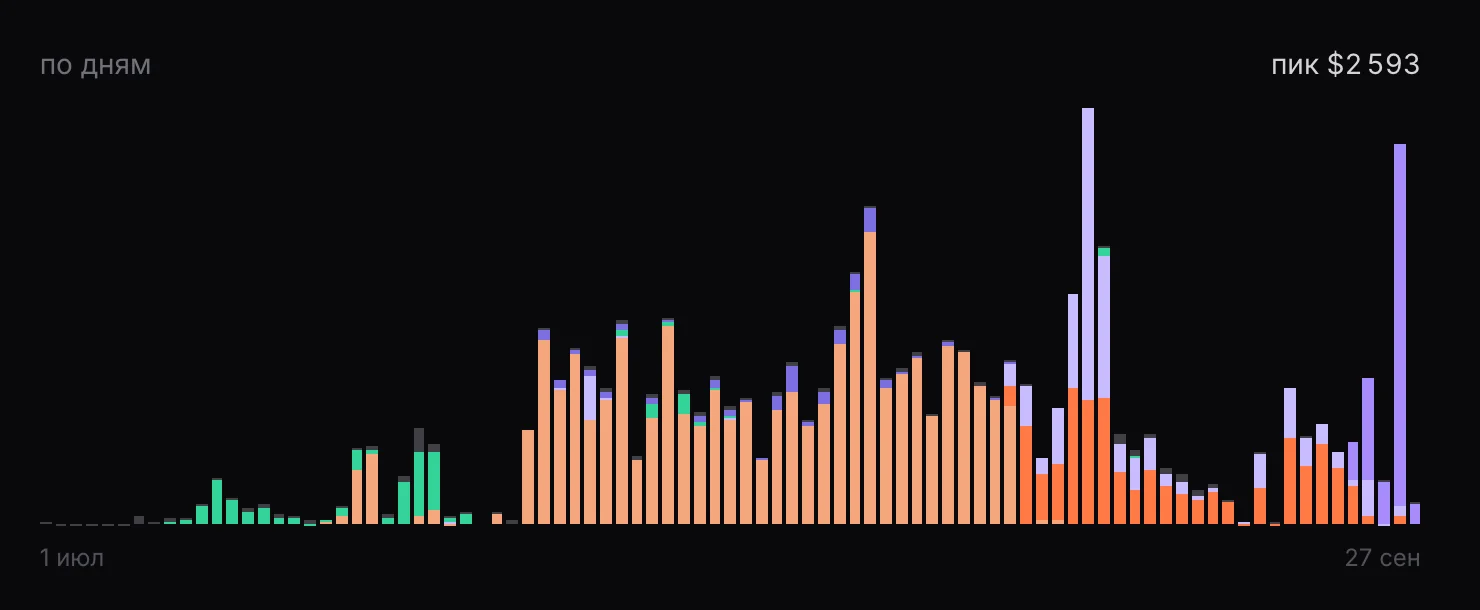
The peak fell on September 6: $2,593 in a single day. Subscriptions cost about $511 a month, so one day at API prices is more expensive than five months of subscriptions.
On the counter page the period switches between 7, 30 and 90 days, since July 1, 2026 or all time, and a click on a model or an agent leaves only those on the chart.
6. Can you trust the counter: how we count and where we got it wrong
Until September 27 we had two counters, and they lied in opposite directions. The open ccusage utility in offline mode put $0 against new models because it did not know their prices, and understated the bill. Our own counter counted a continued session twice, because Claude Code copies the history into a new file, doubled copies of Codex sessions, and did not see subagents.
The audit on September 27 brought it all into one counter. The same counter computes the numbers for /open, so the two pages do not diverge.
How the counter counts
Counter methodology of vibecoding.tech after the audit of Sep 27, 2026.
What the counter does not know. It does not see discounts or negotiated prices, only the price list. The subscription total comes from the spread, not from a receipt. It counts only this site, other projects are not in the numbers.
7. Subscription or API: how to choose for your way of working
The choice is decided by how you work, not by the price list. If you sit with the agent every day and edit code together with it, then your option is the subscription: Claude Code is included in Claude Pro at $20 a month and in Max from $100 with a limit 5 or 20 times higher than Pro's (Anthropic price list, Sep 27, 2026), Codex is included in ChatGPT subscriptions. The only boundary here is the limit, and you will hit it before you hit the price.
If it runs without a human, then API. A cron, a bot, a service that answers customers: a subscription is capped by a limit, and automation will hit it first. On API you pay for every token, so the bill is decided by caching and model choice. The cache pays off after a single read for the five-minute window (Anthropic documentation, Sep 27, 2026), and moving rough work from Fable to Opus 5.5 drops the price of a million input tokens from $10 to $4.
Look at tokens per day, not at the price per million. The price list says what a million costs and says nothing about how many millions will go: on an average day our agent burned 570 million tokens (50.7 billion over 89 days).
The price of a Codex subscription, how limits reset and where the unlimited plans went at every vendor are covered in the article AI subscriptions. .
8. Frequently asked questions
What is a token and how many characters is that?+
A token is a chunk of text, about four characters of English or three quarters of a word (Anthropic, pricing page, Sep 27, 2026). A million tokens is roughly four million characters. At every step the agent sends the model the entire conversation history again, which is why three months of building the site added up to 50.7B tokens.
What do Claude tokens cost via the API?+
Claude Fable 5.1: $10 per million input tokens, $50 output, cache reads $0.25. Claude Opus 5.5: $4 and $20, cache reads $0.20. Claude Opus 5 and Opus 4.8: $5 and $25, cache $0.50. A cache write costs ×1.25 of input for the five-minute cache and ×2 for the one-hour one (Anthropic pricing, checked Sep 27, 2026).
How much does a Codex subscription cost and why do the limits run out?+
Codex is included in ChatGPT subscriptions, it has no separate price. A limit is the amount of work in a time window after which the subscription asks you to wait for a reset. With the API there is no waiting, but every token is billed. Codex prices, limit resets and the chronicle of "where did the unlimited go" are collected in the /podpiski-na-neiroseti article.
Can you buy Claude Code tokens separately?+
Claude Code has no separate tokens. There are two paths: a Claude Pro or Max subscription, which includes Claude Code, and an API key billed at list price for every token. In this article both paths are counted on exactly the same work.
How do you count your own token spend in Claude Code?+
Claude Code stores session transcripts on your computer. Open utilities like ccusage read them and multiply by model prices. Check that the utility has a price for your model: in offline mode ccusage put $0 on new models, and our bill came out too low. Our counter is open on the /open/api-costs page.
What is the subscription multiple?+
How much machine time at API prices one dollar of a subscription buys: divide the cost of the work done at API prices by the price of the subscription. For us it came out to 35. The term, the calculation and multiples across the whole market are in the /podpiski-na-neiroseti article.
Sources
- vibecoding.tech token counter: models, agents, sessions, days (snapshot Sep 27, 2026) — our measurement
- Claude model prices and cache multipliers · Anthropic, API pricing page (checked Sep 27, 2026) — official pricing
- Prompt caching: writes ×1.25 and ×2, reads at the model price · Anthropic (checked Sep 27, 2026) — official documentation
- Messages API: the conversation history is sent in full in every request · Anthropic (checked Sep 27, 2026) — official documentation
- Claude Pro and Max plans, Claude Code included in the subscription · claude.com (checked Sep 27, 2026) — official pricing
- OpenAI API pricing (checked Sep 27, 2026) — official pricing
- LiteLLM: an open registry of model prices, the basis for OpenAI models in the counter — open price registry
- ccusage: a token accounting utility for Claude Code — open utility
- — demand measurement
- AI subscriptions: the subscription multiple and the chronicle of limits · vibecoding.tech (Sep 26, 2026) — наша статья
- Open: the machine versus a team, the same token bill per month — our page
Remember
1. Three months of agents building the site would have cost $52,208 at API prices and cost $1,494 on subscriptions. The 35x gap is the subscription multiple, a number that is not on the price tag.
2. Look at tokens per day, not at the price per million: we went through 570 million tokens a day, and the price list says nothing about that.
3. The expensive model is the one you burn more of. Fable 5 took 55% of the bill, Opus 5.5 burned more than Opus 5 and cost almost half as much. Run subagents on the cheap model: ours took 30% of the tokens and 19% of the bill.
4. If you work with the agent by hand every day, your option is the subscription. If automation runs without a human, a cron or a bot, then API: there the bill is decided by caching and model choice.
5. Trust a counter when it shows its methodology: prices from public price lists, a message counted once, subagents included. Ours is open at /open/api-costs, check yours against it.