
Updated Sep 28, 2026
Claude Code or Cursor: what to choose
Choose your agent
Cursor is a code editor, while Claude Code is an agent in the terminal, and that is the main difference.
Short answer: this is a choice of genre between an AI editor with a $0 entry point and an agent in the terminal, first in the AI agent ranking as of Sep 25.
1. At a glance
 Claude Code
 Cursor
Entry price
from $17/mo
Pro with annual billing
✓from $0
Hobby with limits, no card
Free plan
No
The Free plan does not provide access
✓Yes
Tab and agent with a limit
Models
Claude
Opus 5.5 · Sonnet 5.5 · Fable 5.1
Proprietary + picker
Grok 4.7 · Composer 2.5 · Claude · Gemini · GPT
Context window
✓1M
Right away on any paid plan
up to 1M
Claude has 300K, 1M is chosen separately
Surfaces
✓14
CLI · IDE · desktop · web/iOS · CI · Slack
5
IDE · CLI · cloud · iOS · Bugbot
2. Editor vs. terminal, and that is the key
Cursor is built as an editor: it's a VS Code fork with AI built into the act of writing code. Tab autocomplete writes your next action, the agent lives in a panel next to your files, and cloud agents take long tasks off to their own machines. Since Sep 10, 2026, Projects has been in beta: a coordinator agent splits a big task among other agents.The Windsurf AI environment gets tested on the team's tasks before buying seats for every developer.Roo Code for teams gets checked for its work mode and the permission limits it has on a task.
Cursor has five surfaces in all. Besides the editor there are the CLI, the cloud, an iOS app and review bots like Bugbot, which looks for bugs in pull requests before the merge.
Cursor · editor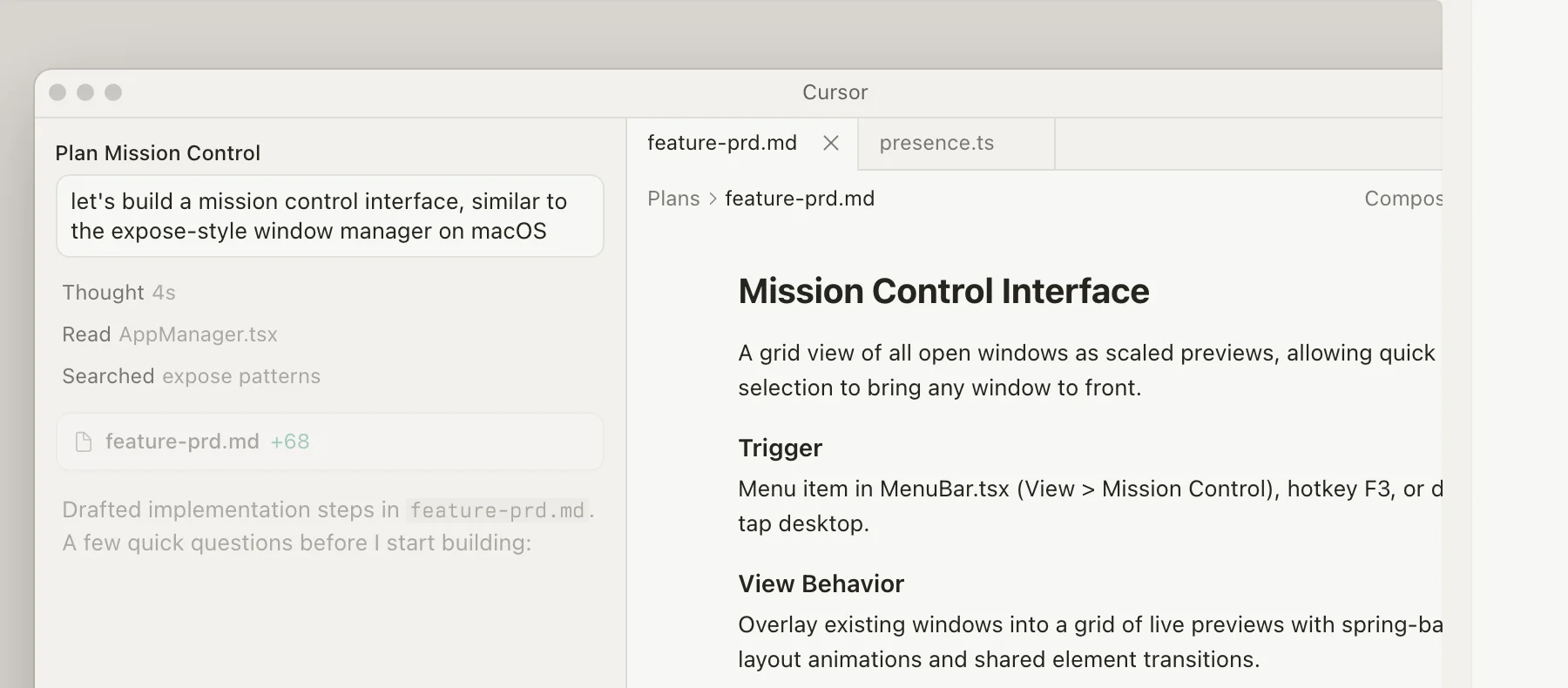
Claude Code was born as a terminal agent and still lives primarily in the terminal. It grows into an existing repository, reads CLAUDE.md, keeps project memory, runs tests and builds pull requests.
Fourteen surfaces have grown around the core. Among them are extensions for VS Code and JetBrains, a desktop app, web and iOS, CI integrations, Slack and an SDK. The character is the same as before: a tool for deep work in existing code, not for autocomplete.
If you want to try one more agent for work on your own or a cloud machine, read the Amp agent card: start with a small task and compare the result in your own project.
Claude Code · terminal
In practice: people choose Cursor when they want to stay in the editor and feel AI on every Tab press. They pick Claude Code when the change is not a single line but a multi-file task, and it's easier to hand it to the agent whole.
3. Only Cursor has a free entry point
Cursor's Hobby plan costs $0 and does not ask for a card: Tab autocomplete and agent requests are included with a limit. Above that, Pro at $20 a month, Pro+ at $60 and Ultra at $200; the plans differ in how much usage is included. A team seat costs $40, or $120 with five times the agent limits, and annual billing is 20% cheaper everywhere.
Claude Code has no free entry point: the Free plan gives no access. Entry costs $17 a month for Pro billed annually, or $20 month to month; heavy scenarios live on Max at $100-200.
Limits work differently. Claude Code has a 5-hour window and a weekly cap, with one shared pool for chat, desktop and terminal.
Cursor has two monthly pools: its own models, Grok 4.7 and Composer 2.5, draw on the first with plenty of headroom, while Claude, Gemini and GPT are billed from the second at their API prices. By Cursor's own estimate, daily work with the agent comes to $60–100 a month.
4. Numbers duel: look at the AA Index, not promises
Comparing agents in words is pointless, that's what AA Coding Agent Indexis for. It measures score, cost and time on real tasks, and every agent plus model pair gets its own result. Latest snapshot from Nov 7, 2026:
61.7
Claude Code + Claude Opus 5.5 max (with fallback)
—
no Cursor pairs in the snapshot
In September Artificial Analysis rebuilt the index, and Cursor CLI did not make it into the new version. In early July it scored 62 with GPT-5.5 and 52 with its own Composer 2.5 Fast, but those scores are not comparable on the new scale.
A score belongs to an agent plus model pair, not to a brand. The full ranking and the methodology are open on the page AI agent ranking.
5. Models and context: different bets
Since Sep 22, Claude Code runs on Opus 5.5 by default, and since Sep 28 there's Sonnet 5.5 for quick tasks. The heaviest, Fable 5.1, is paid for on Pro with credits on top of the subscription. All three have a 1M token window on any paid plan: it fits a sizable part of an average repository.
Cursor is built on two levels. Its own models, Grok 4.7 and Composer 2.5, work for speed and price, and next to them sits a picker with Claude, Gemini and GPT. The window depends on the model: Composer 2.5 has 200K tokens, Claude 300K by default, and 1M is chosen as a separate option.
Cursor's set of models changes along with its owner. On Aug 14, 2026 SpaceX closed the purchase of Anysphere, the company behind Cursor, for $60B. After that OpenAI is winding down the supply of its models to Cursor, with a proposed shutoff date of Nov 12, 2026.
Neither is open source. Cursor is a proprietary VS Code fork with the closed Composer model, and the Claude Code CLI is closed too. Cursor offers Privacy Mode, where models are not trained on your code, on any plan, but you turn it on yourself in settings or through your team admin.Continue assistant for teams requires choosing a model and rules for code access.
6. Which to choose
Choose Claude Code if your work lives in one large repository
With Opus 5.5 and Fable 5.1 it takes the top two spots in the AI agent ranking as of Sep 25. The 1M window works right away on any paid plan, and a sizable part of an average repo fits into it.
Take Cursor if you want to stay in the editor
Hobby is free and needs no card: the editor, Tab autocomplete, and agent requests with a limit. Claude, Gemini, and GPT models unlock with Pro at $20 per month.
What changed in recent months
Claude Code
Sep 22, 2026
Opus 5.5 in Claude Code (v2.1.280): 1M context window, $4/$20 per 1M tokens
Sep 1, 2026
Fable 5.1 in Claude Code (v2.1.257): same price of $10/$50, cache reads 75% cheaper
Jul 24, 2026
Opus 5 in Claude Code (v2.1.219): $5/$25 per 1M tokens, same as Opus 4.8
Cursor
Sep 21, 2026
Grok 4.7 - Cursor's strongest own model for long tasks
Sep 10, 2026
Projects: a coordinator agent splits a large task among agents
Sep 4, 2026