Analysis · Updated 03.09.2026
Agentic development: Ruby on Rails creator explains why he no longer writes code by hand
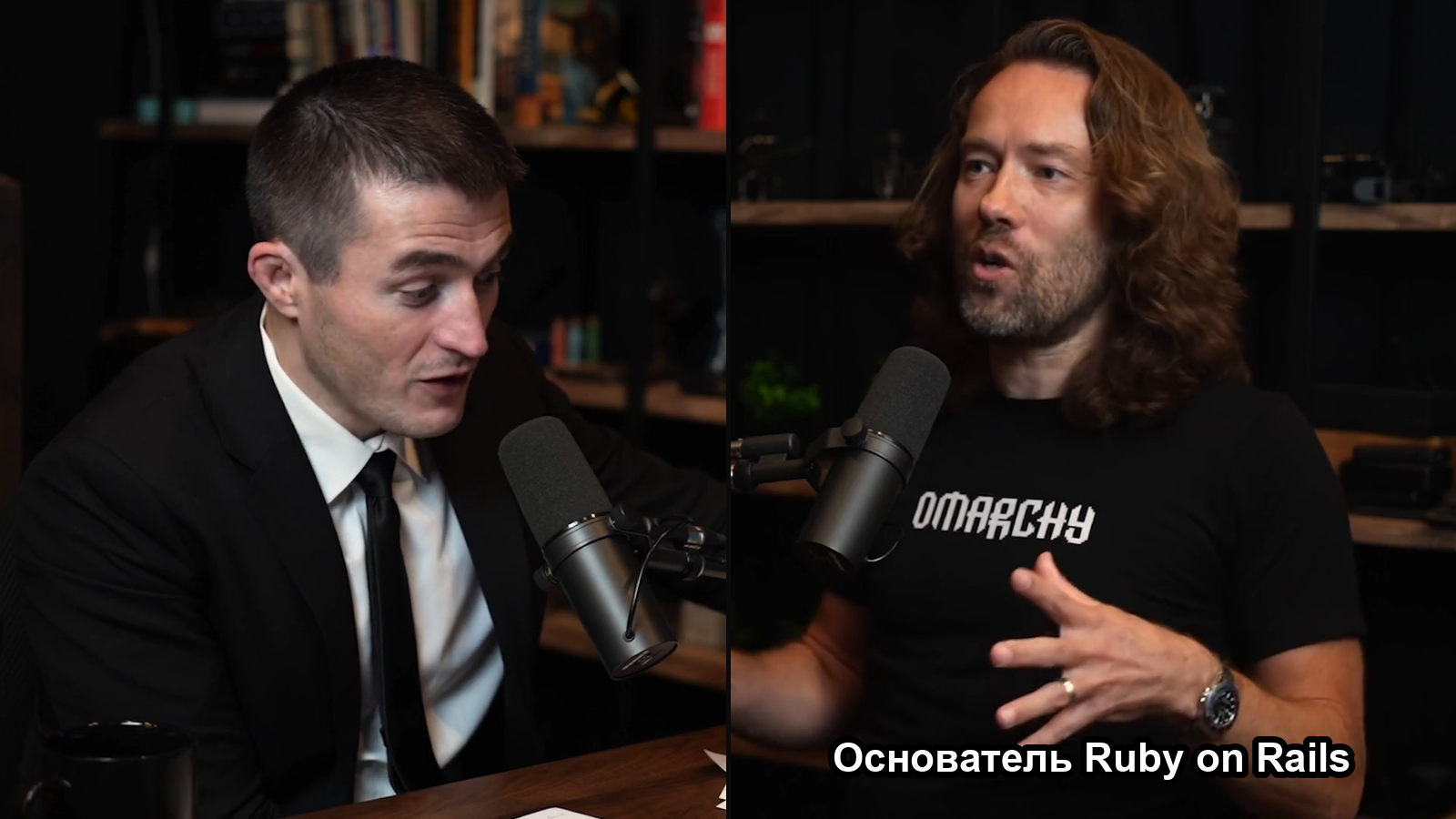
A year ago, Ruby on Rails creator David Heinemeier Hansson (DHH) was teaching Bash against the trend: let the skill stay in your fingers, even if models write faster. Now he does not write a single line by hand. AI agents write the code for his projects, and he says he has never had this much joy from computers in his life.
Analysis of Lex Fridman Podcast #501 from 27.08.2026 · quotes checked against the transcript, facts verified 03.09.2026
On August 27, his conversation with Lex Fridman - 5 hours 15 minutes on how agentic development works for the person who resisted it longer and louder than anyone. We watched the whole episode and condensed it into an 11-minute read: we took only the code and agents, leaving fatherhood, immigration, and longevity overboard. Next, in order: what happened on November 24, where skills go, and what all this changes for you personally.
1. Who DHH is and why his turn matters
If the name means nothing to you: DHH created Ruby on Rails - the framework behind GitHub, Shopify, and Airbnb - and 37signals, the company behind the cult product Basecamp. For twenty years, he was the loudest defender of the craft: small teams, code by hand, no cargo cult. Even people who had not written a single line read his books about the "calm company."
You might think this is another AI evangelist who needs to sell a course. It is the opposite. For someone with that reputation, the "death of handwritten code" is more disadvantageous than for anyone else, which makes his turn all the more valuable. The skeptic who demonstratively learned Bash a year ago now describes the moment like this [37:37]: "Refusing to acknowledge the scale of what is happening - that is the real psychosis."
2. What happened on November 24?
Most AI stories have no date. This one does. On November 24, 2025, the Opus 4.5 model came out. DHH tried it two days later and describes that evening as the moment after which work never returned to its old course [05:54]: "The quality of the output became frighteningly close to what I would have written myself. I leaned back in my chair and thought: what just happened?"
An important detail that is usually missed. It is not only about the model's "intelligence," but the tooling around it [05:54]: the agent got hands - the ability to run commands on a computer, check its own work, and correct itself. A model without hands is an adviser. A model with hands is an executor.
Then eras changed every three months. At first, DHH was "in the driver's seat" and checked every step. In spring, subagents appeared - one agent delegates work to eight others. By summer, he sums it up like this [05:54]: "I no longer say where we are going. I name the problem - the agent chooses the route itself. In the part of work that produces code, I have become unnecessary."
Over the past two months, not a single line written by his own hands has shipped in Omarchy, his Linux distribution [15:42].
3. Is vibecoding programming or not?
That same argument from every chat. DHH has a precise definition [50:36]: vibecoding is when you ask an agent to build a program and do not look at how it works inside. Do not look at all. He does it himself too: he built a replacement for his favorite notes editor in C++ in twenty minutes and never looked at the code [26:33].
You might think the line runs between "real programmers" and "impostors." DHH has a different line - the cost of error. For a pet project or a utility for yourself, vibe code without opening the code. But here is what happened at his own company: Basecamp designers were allowed to vibe code changes in a large live product, and each change separately looked reasonable [15:43] - "but together they destroyed the architecture. We cleaned it up by hand." He notes that this was in February and the tools have advanced since then [15:43], but the lesson about the cost of error remains: on someone else's production system, with money and other people's data, the "without looking" mode ends.
He does not like the term itself, by the way: it reminds him of "script kiddie" from the 2000s [49:09]. And he calls the word agentic marketing soap. By the end of the conversation, he and Lex agree on an unexpected point [01:32:36]: "Okay, let's just call it programming."
4. Will AI replace programmers?
The main fear - and DHH keeps both sides of the scale honest, without comforting fairy tales.
The optimistic side. When programs get cheaper, everyone starts wanting them: demand for software grows faster than the cost of producing it falls. It already happened with ATMs - after they appeared, there were more bank tellers, not fewer [01:10:51]. Plus a sober caveat: the wave of layoffs in IT began with overhiring during the COVID years, and for some companies AI is simply a convenient explanation [03:03:37].
The hard side. He says it too, without anesthesia [01:10:51]: "Productivity growth means fewer people are needed for the same work. For a specific person who was laid off, that is a tragedy - here and now." The Luddites, he reminds us, were not fools from a joke, but highly skilled craftspeople who loved their work. Their craft ended anyway.
Who should be afraid and who should not - his dividing line [01:10:51]: those who loved programming for the mechanics themselves - loops, syntax, debugging - will have a hard time. Those who loved BUILDING face no threat: more builders will be needed than ever.
6. What his workday with agents looks like
The most practical part of the episode. DHH's workflow, step by step:
- Two models for different roles. The smart and expensive one plans and reviews, the fast one executes [02:37:52]: expensive tokens go to decisions, cheap ones to lines.
- Always review with another model. Every job by one agent is reviewed by an agent from another vendor [02:38:14]. In the episode, he recounts an internal Shopify measurement, made back when models were six months less advanced: code reviewed by agents had noticeably fewer production incidents. Agents catch bugs better than people [02:28:10].
- Sixteen agents in parallel. It started with terminal tabs and ended with a farm of four or five mini PCs from the closet, assembled into one network [01:34:56].
- Asynchrony instead of chat. Watching an agent in real time is a trap: "the chat tempts you to sit and wait." His goal is to reduce management to one email a day [02:42:34]: "Here are twelve pull requests: some are ready, some I suggest closing. I only deliver verdicts."
A separate section covers his personal model ranking and the price of a single run. He tested them by rewriting his own terminal engine in Rust [02:31:26].
Models through DHH's eyes: porting a terminal engine to Rust
One practitioner's ratings on one task, August 2026.
And Linux is a separate story. Everything in it is either a config or a command, and agents are at home in it [01:38:53]. Since the start of the year, DHH has not had a single breakage an agent could not sort out on its own [02:24:28]. His forecast is Linux dominating the desktop, because an open system turned out to be the ideal environment for agents.
7. We work the same way - here's what matched, and what didn't
Our project has been built by an agent machine for over a year, so we had something to compare every one of his points against. At times, the overlaps are word-for-word.
The split of "the smart one plans - the fast one executes" was written down as a rule for us long before this episode, in the same form. DHH's farm is made of mini PCs; for us, its role is played by parallel agent desktops on one machine. His "one email a day with twelve pull requests" is our report footer at the end of every run: the agent finishes work with a ready verdict breakdown, and the human only decides. Even a small detail matched: his instructions for agents live in one master file referenced by all the others - we use the same setup.
You can verify the scale in live numbers: on openness page you can see how a machine of dozens of agents builds this site day after day - at the time of writing, the uninterrupted streak counter was approaching ninety days, and agents made more than half the commits.
Where we are stricter than him. DHH allows himself honest vibecoding - never looking at utility code at all. We cannot: we have a production system with payments and other people's data, so every agent step goes through checks, tests, and review, while risky areas go through a human only. His story about Basecamp's ruined architecture explains why.
Where we disagree with him. He advocates vague tasks - "be as unspecific as possible" [57:20]. For code, it works: the agent really knows more about the solution's structure. But where a product has a voice and taste, a vague task produces generic, faceless text - here we maintain strict rulebooks and have no intention of loosening them. The difference is simple: the agent decides the form of the code, the human decides the product's taste.
And this article is proof itself. An execution agent proofread the episode's 54,000-word transcript and made a map of points with timestamps; a human designed the article and wrote the text; the draft went through machine acceptance with every quote checked against its timestamp. Exactly the pipeline DHH describes for five hours.
8. What should I do - beginner or senior?
Calm news for everyone afraid of falling behind [01:23:22]: "Missed the last year - you can catch up with the frontier in two weeks. There is noaccumulated gap here." Tools change so quickly that someone else's year of experience loses value almost instantly - the starting line is the same for everyone.
He explicitly advises against planning a career years ahead [01:17:11]: "Don't try to predict anything. You'll go crazy - even the smartest people cannot see two model generations ahead." His advice is shorter: go where you are interested right now, and build.
The practical minimum for the first week comes from his own framework. Give an agent a real task, not a toy one. Ask a second agent to check the first one's work. Say "make it simpler" and see what changes. If you have been programming for a long time, watch yourself: are you dictating YOUR solution to the agent?
And the most unexpected admission from someone who loved code for twenty years [01:28:37]: "I went into programming not because I love conditional operators. I wanted programs. Now I am back" - over the last three months, computers have brought him more joy than ever before [01:31:30].
9. Frequently asked questions
Where do I start with vibecoding?+
Not with courses. Get a coding agent, a real small task from your life, and one evening. The first working result will explain more than any lesson; where to focus next is above, in "what should I do."
Do you need to know how to program?+
To build yourself a utility, no. To run a live product with other people's data, yes, but what matters most is not syntax, but task definition and acceptance: "software is product management."
Which model is best for code?+
At the time of recording, DHH himself plans with an expensive smart model, executes with a fast one, and has every job reviewed by a model from another vendor. Specific names become outdated within months; the "planner + executor + outside reviewer" setup lasts longer.
Is it safe?+
Exactly as safe as your checks are well built. The cost-of-error rule: for yourself, freely; other people's money and data, only through tests, review, and a human verdict.
Sources
- Lex Fridman Podcast #501 — David Heinemeier Hansson (27.08.2026) — video + official transcript
- Project transparency page: a series of commits and the agents' share — our live data
Remember
1. We date the turning point: since fall 2025, agents have learned not to advise, but to do - and to check themselves.
2. Vibecoding and agent-based development are not synonyms: the first is a "without looking" mode for a low cost of error, the second is a system with checks that works without you.
3. The mechanics of typing code are atrophying; task framing, taste, and acceptance are becoming more valuable. "Software is product management."
4. The working setup of the day: a smart model plans, a fast one executes, another reviews; asynchronously, in batches, with a human verdict at the end.
5. Missed a year - the frontier can be caught up with in two weeks. The best time to try is the coming weekend.