Explainer · Published 09/21/2026
The Jev model doesn't write text, it judges: we put it in charge of our news feed
Jev by TypeSafe AI answers questions with predefined options and a confidence score, but writes no text at all. We ran two hundred posts from our feed through it and compared it with our judge: at a tuned threshold, they matched in three out of four cases, a response from Russia arrived in 0.42 s, and the full run cost three cents.
Text compiled by the editorial team's AI agents under author supervision · facts verified against primary sources on 09/21/2026 · our feed run on 09/21/2026, dataset and code are open
Everyone building something with AI eventually asks a large model the same thing: "is this spam or not," "which department," "how angry is the customer." The model thinks for seconds about such a question and charges for words nobody asked for. On September 15, TypeSafe AI released Jev, a model that writes no words at all: only an option from your list and a number showing how confident it is.
The vendor promises a response in fractions of a second and a price hundreds of times lower. We did not take its word for it: we have our own news feed, where a large model decides every hour whether to take something or not. We had Jev rejudge two hundred posts and compared the results. Next, in order: what it is, the catch with free output, what our run showed, and how to connect it from Russia.
1. What is Jev and why is it not a chatbot?
Jev does not answer in text. You give it a program state, whether an email, ticket, or database record, and a list of questions, each with answer options defined in advance. For every question, it returns the selected option and probabilities for all options. It is a mail sorter that does not write emails, but sorts them into boxes and stamps them "ninety percent confident."
There are three types of questions. Choice selects one item from a list that can have up to 255 options. Score gives a rating on a scale with two to ten levels. Noul answers "yes" or "no" with a number from 0 to 1. You can ask dozens of questions about one text at once; the model calculates them all in parallel, and response time barely increases.
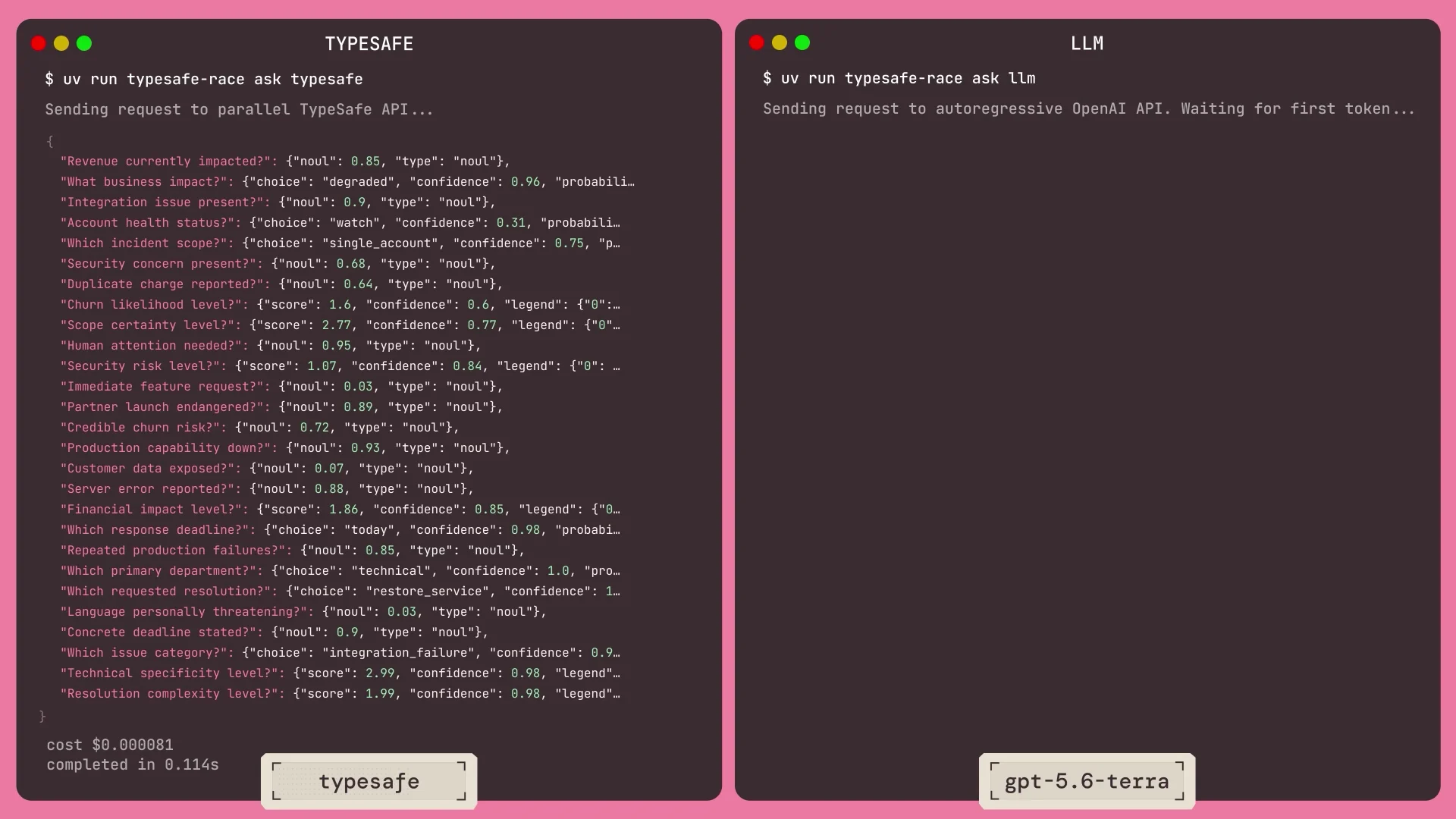
The vendor showed the difference in one frame. One support ticket with three dozen questions was given to Jev and GPT-5.6 Terra. Jev returned every answer in one tenth of a second; the large model was still waiting for its first token.
The company calls it a System One model, after Kahneman's book on fast and slow thinking: fast intuition instead of lengthy reasoning. The model was trained with a method TypeSafe calls RLCD, reinforcement learning for calibrated decisions. As of September 21, there is no scientific paper on either the model class or the method, only documentation and a blog. The model's author, Diogo Almeida, is one of the main authors of InstructGPT, the 2022 OpenAI paper that led to ChatGPT.
2. How does Jev differ from an LLM and a regular classifier?
Jev differs from a large model in what it cannot do. It does not write text or code, view images, or reason step by step. In return, it does not spend time generating: an LLM produces an answer word by word, while Jev calculates all questions about a text in one pass, so its output tokens are free because there are almost none.
At first glance, this is a good old classifier, the kind thousands have been built on BERT since 2018. Hacker News put it this way: "more of a large classification model than a language model," and the founder replied, "very accurate." There is still a difference, and it matters most to practitioners. A BERT classifier must be trained for each task on your labeled data. Jev takes the task from the question text; there is nothing to train.
Convenience comes at the cost of accuracy. A small model trained on the same data scored 93.3% on the Banking77 dataset versus Jev's 83.2%, and answered forty times faster (ickma2311, 09/18/2026). If you have one task, lots of labeled data, and an engineer, your own classifier wins. If you have a dozen tasks and no data, Jev handles them all with one formulation.
Three ways to get a decision from text
TypeSafe documentation and vendor pricing, checked 21.09.2026; response time of our own classifier and Jev from an ickma2311 run on 18.09.2026.
3. How much does it cost, and what's the catch with free output?
There is one price: $0,042 per million input tokens, output tokens are free. In its own documentation, the vendor prices in billions, $42 per billion. TypeSafe has no separate pricing page, and its documentation does not describe a minimum payment or free tier; the price appears only in the model description.
The catch is not the price but the unit. With a large model, output costs more than input because the model generates words. Jev's output is a set of probabilities in a predefined format, with nothing to generate, so there is nothing to charge for. You cannot directly compare "$0,042 versus $3 per million": these are different units of work, and only the price of one task is a fair comparison.
The per-task figures are as follows. One thousand hearing documents cost $0,22 versus $1,31 for DeepSeek without reasoning (Emil Lindfors, 18.09.2026). Checking nine thousand product pairs cost $0,32 (paddo.dev, 19.09.2026). Our run of 768 calls came to three cents. One more caveat from the vendor itself: TypeSafe writes in its blog that it cannot prove the absence of a subsidy and expects the price to fall, while its homepage claims it already serves the model profitably.
Low-cost models for decisions: prices per million tokens
Vendor pricing, checked 21.09.2026.
4. Is it really two hundred times faster?
It depends on what you measure it against. The vendor itself gives four different figures in four places: "a hundred times" in a video, "up to a hundred times" in a press release, "40–200 times" in its blog, and "193,6 times faster and 444,6 times cheaper" on its homepage. The last pair comes from its own measurement across four real tasks, and the vendor itself calls it an upper bound.
We recalculated its table. 193,6 comes from dividing 78,1 s for Claude Sonnet 5 by 0,4 s for Jev, and 444,6 from dividing $0,176 for Opus 5 by $0,0004. Speed is compared with the slowest model in the table, and price with the most expensive. Meanwhile, in accuracy in the same measurement, Jev scored 67,8% versus 74,1% for GPT-5.6 Sol, so the honest framing is not "smarter" but "cheaper at comparable accuracy."
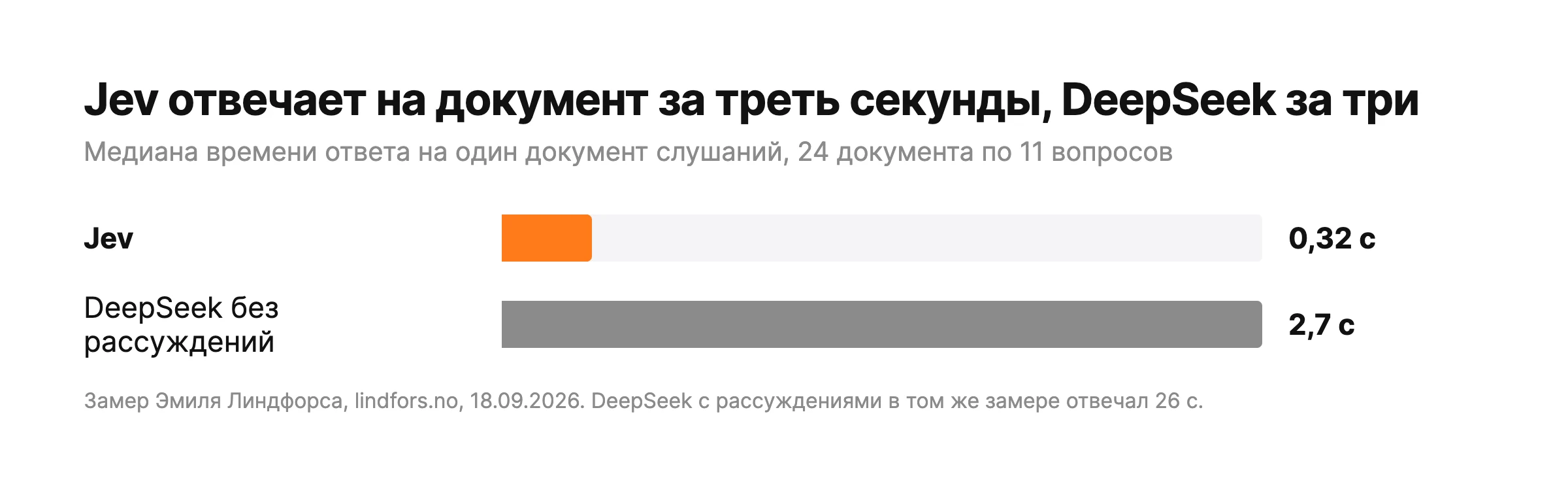
Independent runs converge on a more modest figure. Against low-cost large models, Jev is two to three times faster: 239 ms versus 687 ms for Claude Haiku 4.5 from France (JevBench, 20.09.2026), 0,43 s versus 0,9 s for GPT-5.4 nano (ickma2311). The gap is larger against reasoning models: DeepSeek spent 26 s thinking about a document, Jev 0,32 s.
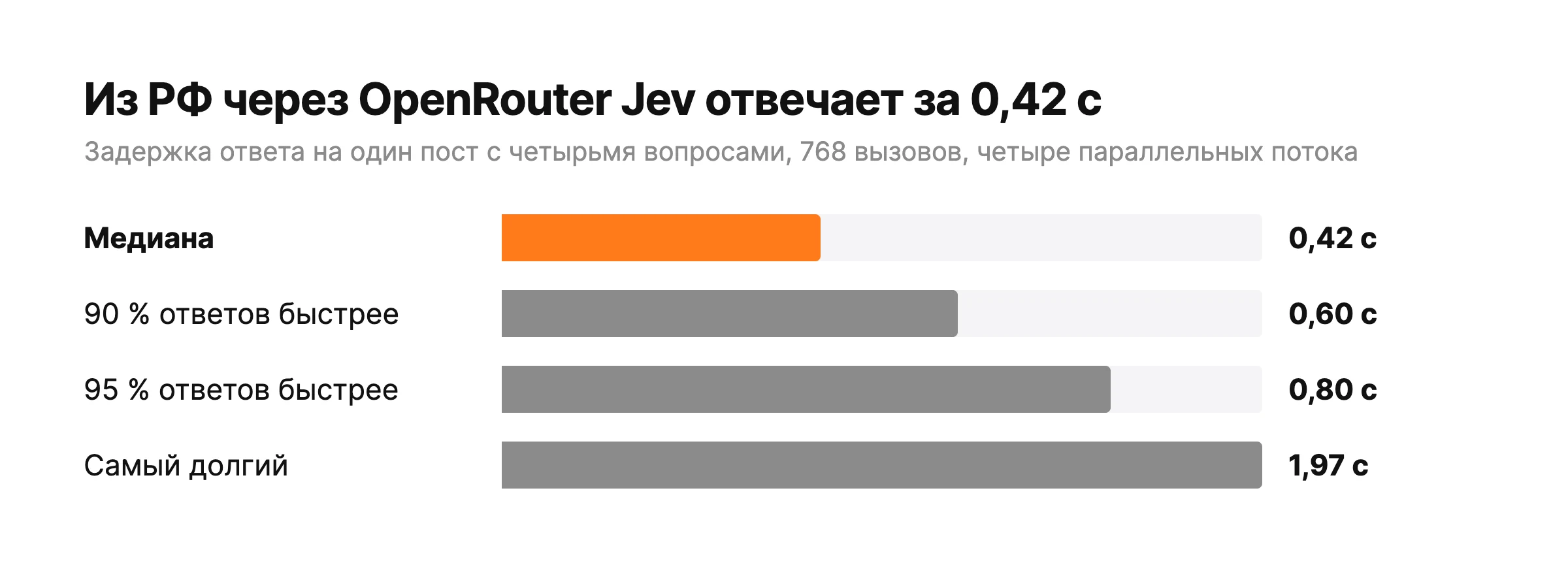
Our own latency measurement is below. From Russia via OpenRouter, with four parallel streams, the median was 0,42 s per post with four questions. The vendor's promised "70–500 ms," qualified as "from our laptops on the West Coast," was almost fully confirmed for us through a gateway and across an ocean.
5. We had Jev judge our feed: what happened?
We have a ready-made task for Jev. The vibecoding.tech news feed collects practitioner posts from X and notes from RSS, and once an hour a large model decides for each one: whether it is on topic for people building software with AI tools, what type of post it is, which feed lane it belongs in, and how many points out of ten it deserves. Over a week, the judge made 857 decisions.
We took the latest 200 posts from X and 184 notes from RSS with the judge's decisions and asked Jev the same four questions used in the judge's prompt: on topic or not, type, lane, score. Each post went in a separate request with its author, text, likes, and views. The judge sees a batch of 25 posts and live feed topics, while Jev saw one post without context. We compared against the judge's decisions, not human labels: this is a match between two models' tastes.
The main result is about the threshold. If an answer is counted as "yes" above a 0,5 probability, Jev found only 13% of the posts the judge included in the feed: it is much more cautious than our judge. But its probabilities rank posts honestly. Among those where Jev gave 10 to 20%, the judge included 41%; from 20 to 30%, already 69%; above 60%, every single one. The more confident Jev is, the more often the judge agrees, its scale is simply shifted downward.
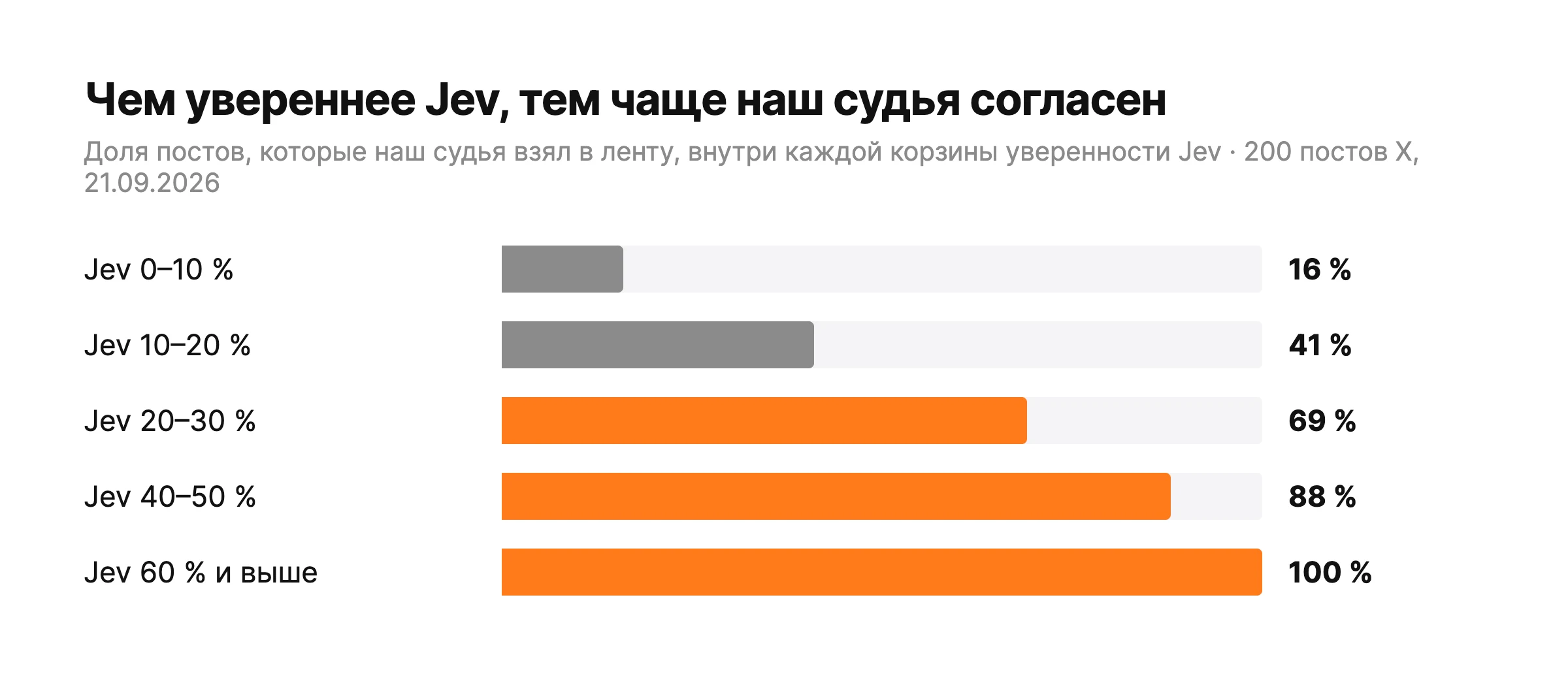
So the threshold for our task should be 0,2 rather than 0,5. Then Jev matches the judge on 76,5% of decisions and finds almost half the posts it included, with one false positive for every three true positives. The table below shows how agreement changes with the threshold.
Jev's agreement with our judge on 200 X posts at different thresholds
Our run on 21.09.2026, English-language questions. Feed judge: a large model using the judge-v8 prompt with the owner's examples.
Where Jev and the judge disagree, the disagreement is meaningful. The judge gave a seven to Elon Musk's posts because its examples include such posts that the editors had previously skipped and regretted. Jev gave them 0,01 to 0,07: it judges from scratch based on the wording of the question and has no taste examples. But both models confidently included several posts by Tobi Lutke and Guillermo Rauch about practical techniques.
The result for Russian was unexpected. We repeated the run after translating all four questions into Russian. The "include or not" decision matched the English version for 96,5% of X posts and all 184 RSS notes, with a median probability difference of 0,01. Russian questions use 58% more input tokens, and that is the entire cost.
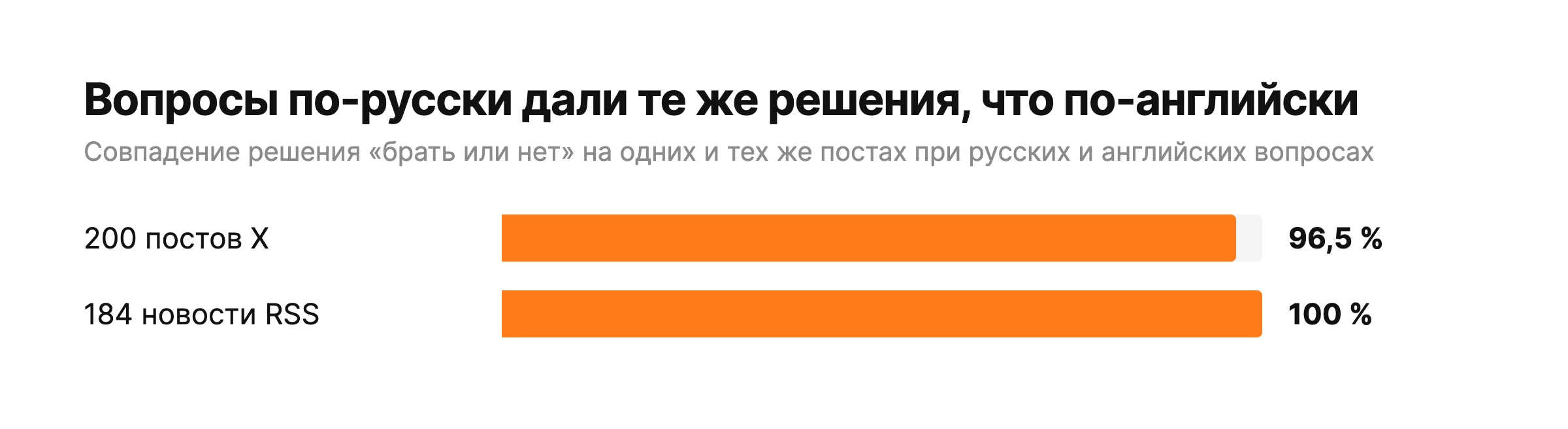
Russian texts performed worse, but this is not about language. Our RSS section consists almost entirely of business media, RBC, CNews, Kommersant, and the judge includes 28 of 184 notes from them under its own loose rules. At a 0,5 threshold, Jev included none; at 0,15, three. You cannot separate "doesn't know Russian" from "not our topic" without a separate dataset, and the vendor only writes that English is the model's primary language.
What we learned. Jev will not replace the feed judge: it sees topics and the editorial taste, while it sees one post. But it works as a first filter before the expensive judge: our judge also includes everything below 0,1 in only one out of six cases, and such posts make up more than half. Filter them out for three cents and 0,4 s per post instead of running the large model in full, that is its place.
6. How do you connect it, and what does a call look like?
TypeSafe itself offers access through a waitlist: apply on the site, then get a key after an invitation in the console. Its documentation does not describe a free tier or starter credits. Three gateways offer the model without a queue: OpenRouter under the name typesafe/jev-1.13, Vercel AI Gateway, and Cloudflare AI. We used OpenRouter, which has the same price and regular account billing. From Russia, it works through the same route as any foreign API: foreign payment and a gateway where you already have an account.
There is one call, and OpenRouter uses the same format as TypeSafe. state contains the text, and questions contains a list of questions with options. Here is our request about a feed post, shortened to two questions, and the model's response.
POST https://openrouter.ai/api/v1/systemone
Authorization: Bearer <OpenRouter key>

{
  "model": "typesafe/jev-1.13",
  "state": { "author": "@tobi", "text": "…post text…", "likes": 1200 },
  "questions": {
    "relevant": {
      "type": "noul",
      "instructions": "Is the post useful to practitioners building software with AI tools?",
      "criteria": { "true": "yes, worth knowing or applicable", "false": "no, off topic" }
    },
    "lane": {
      "type": "choice",
      "instructions": "Where does the post belong in the feed?",
      "criteria": { "breaking": "market fact", "practical": "technique", "ignore": "not for the feed" }
    }
  }
}

// response:
{ "answers": {
      "relevant": { "type": "noul", "noul": 0.61 },
      "lane": { "type": "choice", "choice": "practical",
                "probabilities": { "breaking": 0.05, "practical": 0.83, "ignore": 0.12 },
                "confidence": 0.71 } },
    "usage": { "input_tokens": 780, "output_tokens": 0 } }
Limits as of 21 September: 64 thousand tokens per request and 32 thousand for text together with the longest question, up to 255 options in one choice, 1 200 requests per minute. The vendor warns that limits fluctuate and change without notice while demand exceeds capacity. There are SDKs for Python and JavaScript, and a skill for coding agents is available: in Claude Code it installs with one command and explains to the agent how to write questions.
Where to get Jev
TypeSafe and gateway documentation, checked 21.09.2026.
7. Where Jev pays off: practitioner cases
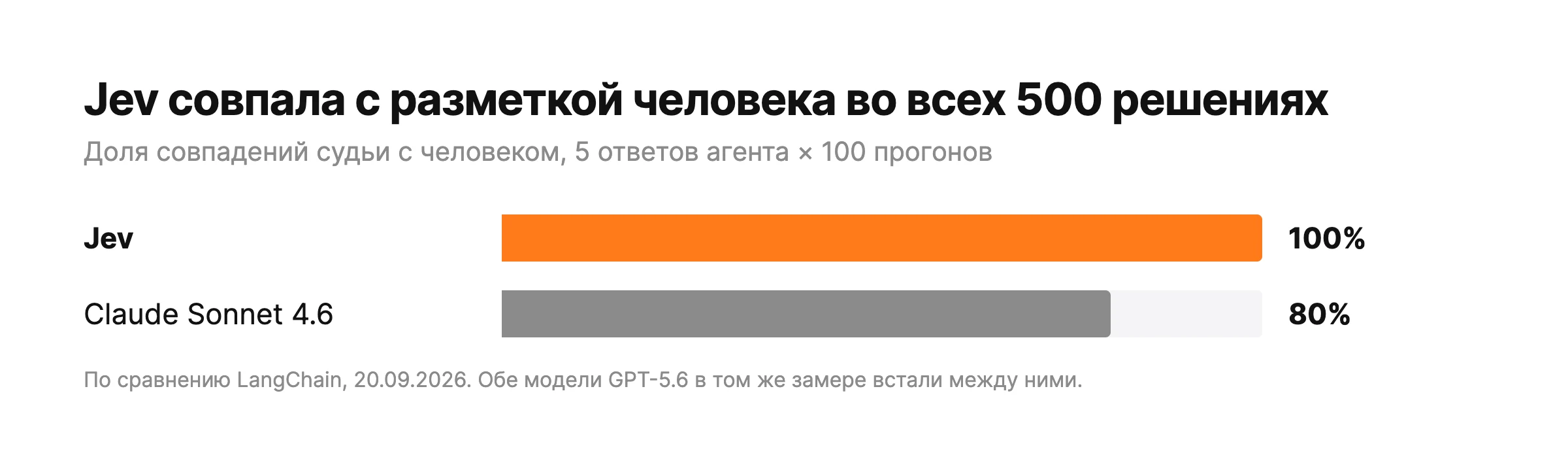
Jev looks strongest where someone is already checking others' answers by the hundreds. LangChain engineers ran five weather-agent responses one hundred times each through four judges and compared them with human annotations. Jev matched the human in every case, Claude Sonnet 4.6 was wrong one time in five, and the run cost 80 times less (20.09.2026).
Second scenario: long documents with short questions. Emil Lindfors gave Jev two dozen documents from Norwegian hearings on resource rent and asked it to determine each author's position. The model was correct five times out of six and responded in a third of a second, while DeepSeek without reasoning took nearly three (18.09.2026). Detailed question wording, to the author's surprise, made it less confident.
Third: Russian data. Vitaly Trenkenshu matched OKTRU codes to government procurement line items and asked models to choose the best code from a list of candidates. Jev selected the needed code more often than any other model, including Gemini 3.1 Pro, which cost 60 times more, and repeated its decision from run to run in 98% of cases (Habr, 21.09.2026).
Where it loses is also known. It cannot see images: Bartosz Mikulski converted four hundred drawings into text and asked it to guess the object; Jev guessed one in three and called more than half of them an airplane, while Claude Sonnet 5 guessed nine out of ten from images (19.09.2026). And Almeida himself advises against asking one big question such as “can this code be deployed”: the model is strong at small questions that combine into more complex tasks.
8. Can you trust it: hallucinations, author, measurements?
“Zero hallucinations” on the TypeSafe homepage means the response format, not its correctness. The model cannot return an option outside your list, which is true by design. It can choose a wrong option, and the vendor says this plainly in its FAQ: the format is guaranteed, not the correctness of every decision.
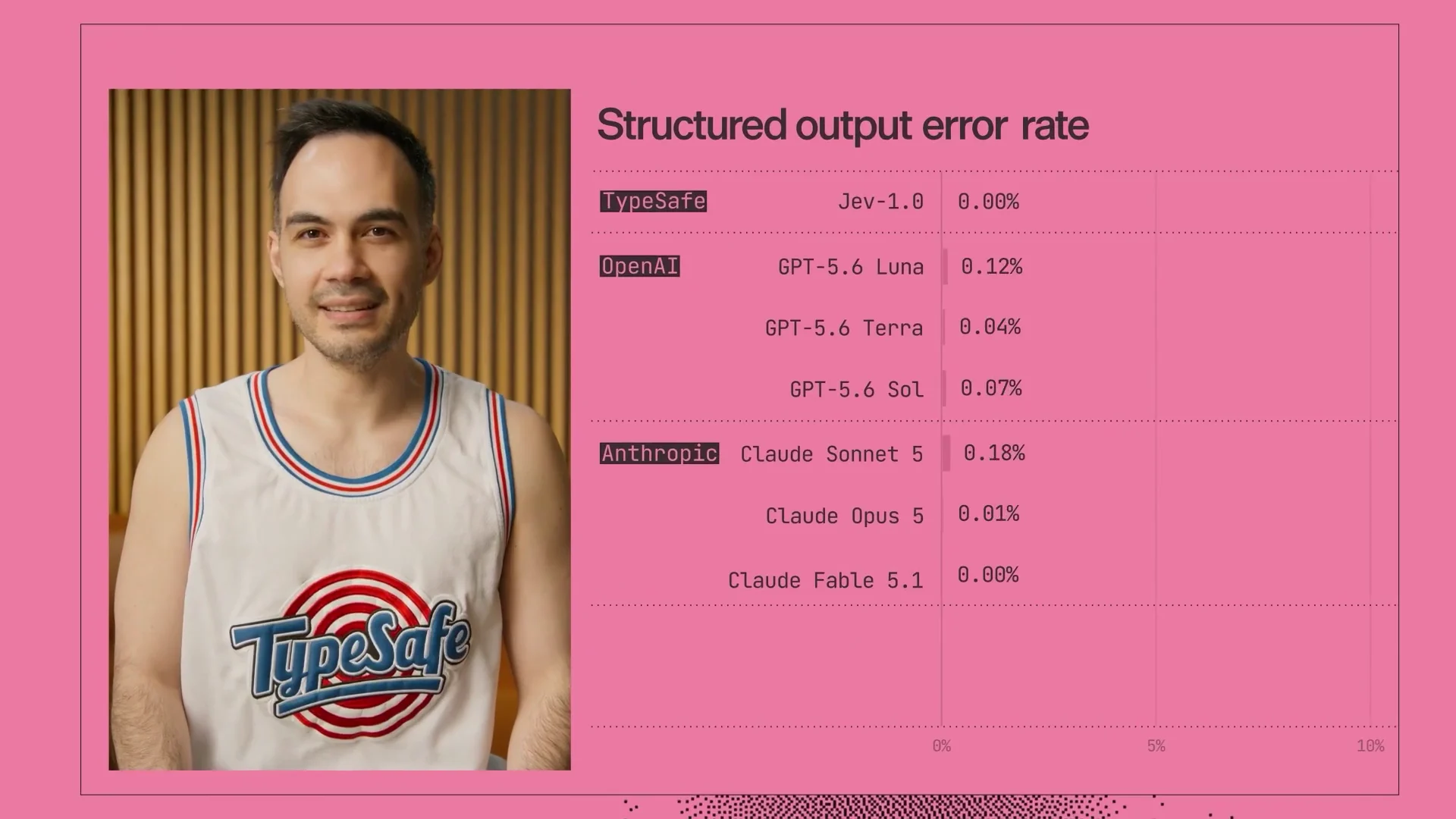
The second promise, honest confidence, is harder to verify. Calibration is claimed for groups of answers: of decisions with probability 0,8, eight out of ten should be correct; this guarantees nothing about an individual answer. The vendor has published no papers, calibration curve, or error figures. Our run showed that Jev probabilities rank posts in agreement with the judge, but the scale is shifted, and the threshold will need to be tuned to your task.
Accuracy depends heavily on how the question is asked. On phishing emails, Jev with one question scored 62,6% versus 81,3% for Claude Haiku 4.5, and 95,0% after breaking it into five questions with selected weights (XenoSpectrum, checked 21.09.2026). A simple regular expression on the same set gives 91,8%. The vendor itself maintains a weaknesses page: the model does not calculate, reads dates as text, understands questions literally, and is vulnerable to adversarial inserts in text.
Who is behind it. Diogo Almeida is the fourth of twenty InstructGPT authors and one of fifty contributors to the ChatGPT launch blog. The words “co-inventor of ChatGPT” from his tweet do not appear in OpenAI documents. The company was founded in 2024 in San Francisco and received $40 million from DCVC on 15 September. According to the documentation, the model does not train on customer prompts, cannot be fine-tuned on your data, and its weights are not released.
What is promised and what is verified
Checks are dated 18–21.09.2026.
9. Frequently asked questions
What is Jev in plain English?+
A TypeSafe AI model that does not write text but answers questions with predefined options. You give it text and a list of options; it returns the selected option and a confidence score from 0 to 1. It launched on September 15, 2026 in early access via a waitlist; it is pronounced "Jev."
Is it true that Jev does not hallucinate?+
No, if you consider a wrong answer a hallucination. The model cannot return an option outside your list, and that alone is what the vendor calls "zero hallucinations." It can choose the wrong option; TypeSafe says so directly on its website.
How much does Jev cost?+
$0.042 per million input tokens, output tokens are free, and the vendor has no separate pricing page. Our run of 768 calls cost three cents. The documentation does not describe a free tier or starter credits.
How can you access Jev from Russia?+
TypeSafe uses a waitlist and charges after login, while the vendor does not name supported countries or cards. Gateways offer the model without the queue: OpenRouter under the name typesafe/jev-1.13, Vercel AI Gateway, and Cloudflare AI. We called it through OpenRouter, where billing is standard.
Does Jev work in Russian?+
It understands questions in Russian: in our run, Russian and English wording produced the same decision for 96.5% of posts. The vendor says English is the model's primary language for Russian texts; it rejected almost all Russian RSS news, though the topic was not ours either. Test it on your own data.
How does Jev differ from GPT-5 nano or Claude Haiku 4.5?+
Those can write text and view images; Jev cannot. But it answers in fractions of a second, costs $0.042 per million input tokens versus $0.05 and $1 for its neighbors, and output is free. On phishing with one question, Haiku 4.5 was more accurate; after breaking it into five questions, Jev pulled ahead.
Who is Diogo Almeida?+
Founder and CEO of TypeSafe AI, previously a researcher at Google Brain and OpenAI. The fourth of twenty authors of InstructGPT, the 2022 paper that led to ChatGPT. The phrase "co-inventor of ChatGPT" from his tweet does not appear in OpenAI documents; it is his own wording.
Sources
- Introducing System One Models & Jev · TypeSafe blog (09/15/2026) — official release
- Jev 1.13 model: pricing, limits, context · TypeSafe documentation (verified 09/21/2026) — official documentation
- API reference: three question types (verified 09/21/2026) — official documentation
- Jev 1.13 jaggedness: nine weak spots (09/17/2026) — official documentation
- Workflow evals: four tasks, accuracy, and cost per case (verified 09/21/2026) — official measurement
- TypeSafe AI homepage: questions and answers (verified 09/21/2026) — official website
- Press release: $40M from DCVC, founded in 2024 (09/15/2026) — official release
- Diogo Almeida launch-announcement tweet with launch video (09/15/2026) — official statement
- Almeida: "jev does better with smaller decomposed questions" (09/17/2026) — official statement
- InstructGPT: author list · arXiv (03/04/2022) — original publication
- OpenRouter: TypeSafe SDK and System One API (verified 09/21/2026) — gateway documentation
- Our run: 384 items from the vibecoding.tech feed through Jev, raw data and code (09/21/2026) — our measurement
- jev-baselines-eval: Banking77, nano, Terra, and a trained classifier (09/18/2026) — independent measurement
- JevBench: full Banking77 and latency from France (09/20/2026) — independent measurement
- XenoSpectrum: phishing, one question versus five (verified 09/21/2026) — practitioner's account
- Vitaly Trenkenshu: Jev versus LLMs for OKTRU codes · Habr (09/21/2026) — practitioner's account
- Emil Lindfors: 24 hearing documents for half a cent · lindfors.no (09/18/2026) — practitioner's account
- Replacing an agent classification loop with Jev · blog.r6i.it (09/21/2026) — practitioner's account
- Bartosz Mikulski: 400 drawings, Jev versus Sonnet 5 (09/19/2026) — practitioner's account
- paddo.dev: 9,081 product pairs for $0.32 (09/19/2026) — practitioner's account
- LangChain: Jev as a judge of agent traces, 500 decisions (09/20/2026) — independent measurement
- Hacker News: launch thread and founder replies (09/15/2026) — practices
- TechCrunch: new model from ChatGPT inventor delights developers (09/18/2026) — press
- OpenAI: GPT-5 nano pricing · Anthropic: Claude Haiku 4.5 pricing · Google: Gemini Flash-Lite pricing (verified 09/21/2026) — competitors' pricing
Remember
1. Jev does not write text: input is text plus questions with options, output is an option and a probability. Use it where code already asks an LLM to select an item from a list.
2. “Zero hallucinations” guarantees the response format, not correctness. Tune the confidence threshold to your task: for us, 0,2 worked rather than 0,5.
3. The speed advantage over inexpensive models is two to three times, and over models with reasoning it is dozens of times. From Russia through OpenRouter, the response arrives in 0,42 s.
4. Put it as the first filter before an expensive judge, not instead of one: it does not see context or editorial taste, but filters out junk for three cents across hundreds of posts.
5. Questions can be written in Russian, and the decisions do not change. Test it yourself on Russian texts: English is the model's primary language.